

Experience report - Support agile teamwork with Echometer
Experience report - The format
How is Echometer actually used in practice? And by whom? We want to answer these questions in a number of Echometer testimonials . In this series, we will interview some of our users.
Our series continues with Veronika Renn’s experience report. Veronika is a Scrum Master at Bytabo.
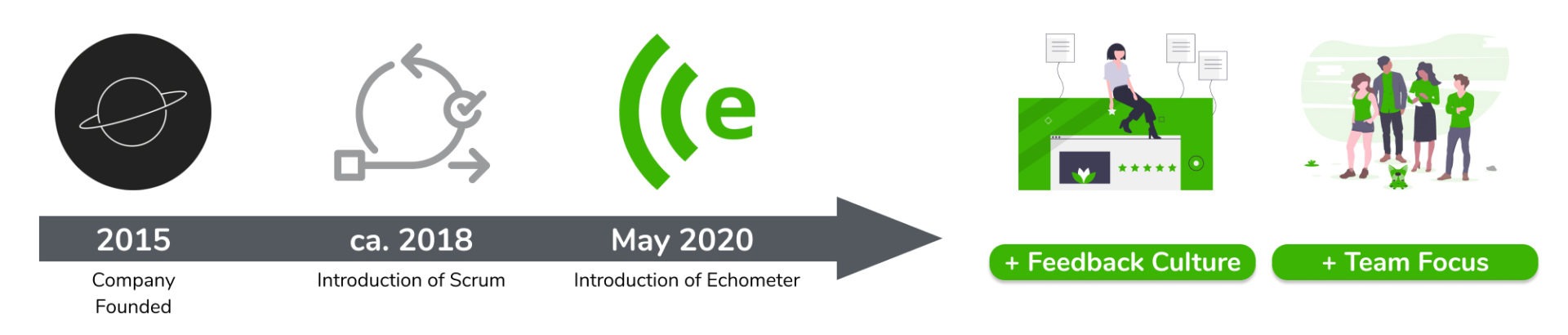
Bytabo is a company founded in Bamberg in 2015 that supports medium-sized companies on their way to the digital future. It helps to digitize the processes in the core organization, to develop a culture of innovation and set up new business models.
Introduction to Veronika and her experiences with agile work
Echometer: Hello Veronika! We are pleased that you are taking the time today to tell us about your experiences with Echometer.
To begin, would you like to briefly introduce yourself and explain how agile work is implemented in your company?
Veronika: I have been with Bytabo as a Scrum Master since March. About 2 years ago, the scrum process was introduced here and, along with it, agile ways of working. So, back then. I already thought the idea of working with Echometer was really cool!
Echometer: With the introduction of the scrum process, how does the cooperation in your team look like now? Can you describe it?
Veronika: Of course! The Scrum process has definitely changed a lot compared to the beginning. In the beginning, everything was very much divided according to areas of responsibility - there were usually Scrum meetings, the Dailys and the Plannings. Since I’ve been there as a Scrum Master, we’ve switched the processes to cross-functional structures, as it should ideally be today. This means that a Scrum team consists of developers, designers and product owners and we always meet in the Dailys for important input. Communication and implementation work very well, but we continue to optimize our processes. We meet every morning for the Daily, our sprints usually last two weeks and at the end of each sprint we have a review and a retro. Shortly before that, we usually have a refinement and at the beginning of the next sprint a sprint planning.
Distributed work in the Scrum team
Echometer: How does it look like where you work? Are you mostly working remotely?
Veronika: At the beginning of Corona, i.e. from mid-March and throughout April, we worked completely remotely. After that, we started having some people coming to the office in a restricted and scheduled manner 1-2 times a week.
Echometer: Has working remotely changed anything fundamentally?
Veronika: Overall, the readjustment worked well for us because we already had the opportunity to work remotely before the Corona crisis. In the digital world, it’s usually pretty easy to move your work to another space. In the beginning it was, of course. a challenge to plan how exactly we would do it, but we quickly found a routine that worked for us.
Use of Echometer at Bytabo
Echometer: You’ve been there since March - how long have you been using Echometer?
Veronika: We started using it shortly afterwards. We had our first session with Echometer in mid-May.

Expectations from the tool
Echometer: What were your expectations of the tool?
Veronika: I think I was basically looking for a tool for our retros that was also designed to work well remotely. Many tools are designed solely for teams where all members are in the same room, so I found Echometer very good from the start. The software is also designed so that everyone sits in front of their own computer during the retro.
I was hoping for a tool that sees the challenges, uses them and supports communication, which is sometimes a bit more difficult when you are not all together in one room.
The process of retros with Echometer
Echometer: You said earlier that you guys have a retro after every sprint. Can you explain in more detail, how you use Echometer in your work?
Veronika: We use Echometer for the retrospectives and use it throughout the company. I really like the idea that the items have been designed from a psychological point of view! A small difference in the wording can often lead to a completely different output. I click through the questions, have the retro questions put together and adjust them a bit. I prepare the retro and then we go through the questions in the group and discuss them. If comments came up during the retro, they were recorded in comments - so everyone had the opportunity to look at them afterwards.
“The tool was incredibly well-received!”
- Veronika Renn (bytabo)
The function that everyone can indicate that they want to move on to the next topic is, in addition to the reactions, a frequently used function. Sometimes you interrupt each other just to agree with another person, which is prevented by the reactions - the person is not interrupted and still receives the approval of the other. In the last few times I have increasingly used the function to bring in my own questions. This function offers the possibility to specifically address things that have just happened in your own company. Such things are difficult to ask in general. We also entered the measures afterwards.
Added value through the use of Echometer
Echometer: Do you have a specific example of a situation where Echometer has brought you added value?
Veronika: I can think of two examples of this. On the one hand, we deal intensively with feedback culture, an aspect in which Echometer supports us very well, as the tool provides many items on this topic and gives us the opportunity to approach feedback a little differently than before. I think that’s very good!
Furthermore, Echometer focuses increasingly on the company and corporate culture. Before, our focus in our retros was on workflows and methods. With Echometer, we started to focus more on the company and our team.
For example, we do this through items that ask how connected the employees feel to the company’s goals.
“With Echometer we started to focus more on the company and our team”
- Veronika Renn (bytabo)
Veronika’s tip for using the tool
Echometer: Do you have a tip that you would like to share with other companies that use Echometer?
Veronika: The tool has undergone significant further development lately and offers customers many options. It is important to be aware of these options, because the variety gives the customer a lot of individual design freedom for the retros. Since using Echometer, I have noticed many positive changes, most notably that my ideas and suggestions for improvement were taken seriously and some of them were even implemented directly.
Our interview partner
Veronika Renn
Scrum Master at bytabo
“Since everyone uses the tool in a different way and everyone has their own ideas, the active feedback from users turns the tool into software that is ingeniously tailored to the company.”
- Veronika Renn (bytabo)
Final conclusion
Echometer: Finally, do you have any final feedback for your first few months of using Echometer?
Veronica: The tool was extremely well received by our team, because there are so many opportunities for interaction in the retros. Even if more and more of our team are currently working remotely, everyone can easily contribute through reactions and comments. The team members do not have to interrupt each other with speech, which avoids complications and misunderstandings, and the user can adapt the tool to their own needs thanks to the individual freedom of design, such as the introduction of their own questions.
Echometer: Thank you for taking the time to tell us about your experiences with Echometer!
Lena from Shopware recently shared her experience with us. Click right here to see what Lena has to say about using Echometer!
Did that sound exciting to you? Would you like to get to know Echometer better?
Take this opportunity to create a free demo account to create and design the next retros with Echometer! 🙃
If you’re already on board and would also like to report on your experiences - please get in touch!


