

6 ways to create a fruitful feedback culture
Many companies desire for an established feedback culture, but what exactly does that mean? Because everyone loves definitions, we will start with a definition of this term:
Definition of a feedback culture
What constitutes a feedback culture? It is affected by mutual trust among all collaborators, cross-hierarchical Communication: and regular feedback on ways of working, performance and impact on outsiders.
Importance and advantages of creating a feedback culture
A question that often arises from this topic is: What are the advantages of creating a feedback culture? First of all, one must know that giving, accepting and implementing constructive feedback can simplify and make the work process more effective.
Anchoring this in an open feedback culture comes with the following advantages:
- Transforming into a learning organization : using feedback as a source of understanding and development helps increase productivity (cf.Shipper, Hoffman & Rotondo, 2017)
- Reducing stress and conflicts through regular feedback leads to healthier and happier employees (cf. Ansel & Lievens, 2007)
- Direct communication and increased satisfaction lead to increased commitment of employees (cf. Rosen, Leven & Hall, 2006)
So you can see: a practiced feedback culture not only has a positive effect on the work process, but also on the working atmosphere.
Use sharable study by Amadeus Fire also shows that the more satisfied employees are with the feedback culture, the more satisfied they are with the work in general.
To maintain the feedback culture, companies also often integrate software solutions that facilitate 360-degree feedback. The British software system SenseHR, for example, is a comprehensive platform for the seamless management of feedback processes (More on: the SenseHR software system UK-based). Such solutions, like SenseHR, can help companies not only collect feedback from various sources, but also effectively analyze and act on it to get a better picture of performance.
Who wouldn’t like having satisfied, motivated and effective employees?
We now know what a feedback culture is by definition and what the advantages are of creating one, but how can we determine whether it is actually being practiced?

"Many team members are afraid to speak up!"
Solve this challenge
"We discover too many unexpected issues & bugs at a late stage!"
Solve this challenge
"Why does it sometimes take me hours to prepare a simple retrospective?"
Solve this challengeAssessment: Is feedback culture practiced?
Although many people are aware of the advantages of an established feedback culture, many companies unfortunately do not fully practice it. The Randstad work barometer 2019 shows that feedback is given annually in only 35% of German companies. 32% of companies, however, never give feedback. If feedback is given, it often happens in an inopportune way: 30% of respondents stated that they did not know how to react to feedback, 24% take negative feedback personally, and 21% feel uncomfortable when they receive feedback.
Given the relevance of feedback, these results are rather poor. Hiltrud Werner, board member of Volkswagen AG, even says that more feedback could have prevented the Volkswagen emissions scandal (s. Schielke, 2018).
“It is not easy for everyone: Both for the feedback provider and for the feedback recipient. The team just has to understand that it is worth thinking along, discussing and trusting one’s own gut feeling that it is worth opening your mouth. ”
- Hiltrud Werner, board member VW
Therefore, there are now integrity ambassadors at Volkswagen who ensure that a culture of discussion is practiced and implemented. With the support of regular feedback, there should be no more scandals in the future.
Many companies are aware of the importance of a functioning and established feedback culture and have established one in their company or are in the process of developing it.
The topic of “feedback culture” is trending
The trend is moving towards feedback culture: Young companies in particular are using this. Many startups rely on creating a feedback culture, especially since younger employees, also known as millennials, request feedback for optimal further development. Thus, feedback cultures are becoming increasingly important in order to attract and retain new potential workers.
Not only young companies have recognized the benefits of regular feedback. Even large companies such as SAP, DB and Telekom want to move away from the classic annual appraisal interview (Armin Trost, s. Schielke, 2018) and are therefore looking for new methods.
A feedback culture is more than an annual employee interview, which psychologist Armin Trost (s. Schielke, 2018) believes. Rather, it is about regular exchanges and constant feedback. A feedback culture must therefore be practiced and, above all, implemented effectively. But how?
How to: create a feedback culture
First of all, it is important to remember that feedback cannot be equated with criticism. Feedback is an acknowledgement, and should be used as such. There are several Tipsthat show you the right way to introduce a feedback culture.
Our tips are:
Mache dir vorher Gedanken, was du sagen möchtestIf you yourself are not clear about what your message is, it will most likely not reach your counterpart the way you planned it to. Make sure beforehand what the core message of your feedback should be.Sage immer auch etwas PositivesThe feedback is there to illuminate the work process from all sides, so always speak up about things that went well. In a best case scenario, use the sandwich method: Praise, criticism, praise.Feedback muss nicht immer negativ seinRegular praising of things that went well is also part of a good feedback culture. Even if there is nothing to criticize, you can and should give feedback- even if it’s only positive things.Sprich aus der Ich-PerspektiveDon’t formulate the feedback as an accusation, such as “You have …”, but formulate an I-statement “I feel/perceive …”. Feedback is always subjective and this should also be clear from the wording.Erfrage immer auch die andere PerspektiveAlmost every story has two sides. So always ask your counterpart how he felt, in order for you come to a common denominator and build mutual understanding.Initiativ nach Feedback fragenYou don’t always have to wait for feedback! Feedback not only helps the entire team, but also everyone individually in their personal development. Get active feedback to keep growing.

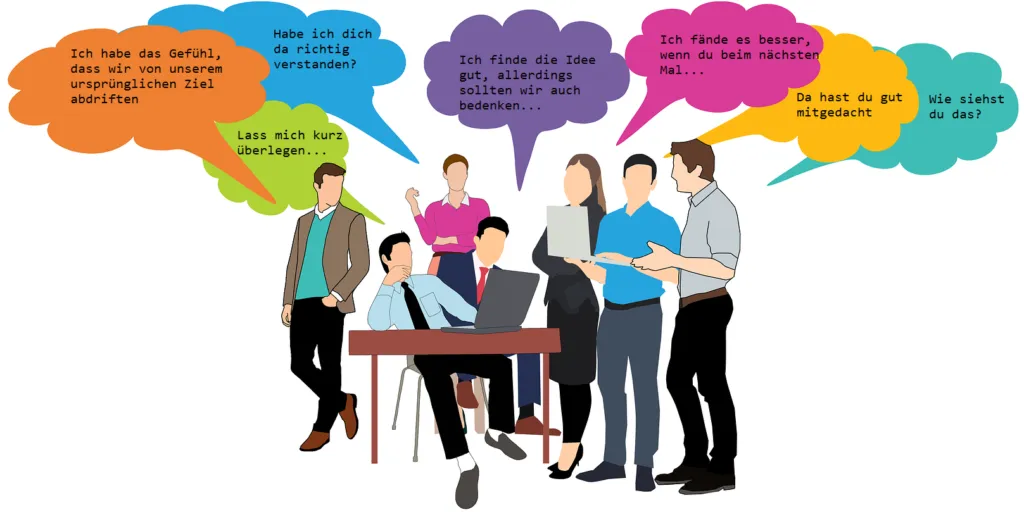
The whole thing should take place at short intervals, for example 1 to 2 times a week.
Take your time sensibly. The introduction of a feedback culture is not a way to punish or control anyone, but should help everyone to develop both individually and collectively.
Feedback culture through 1-to-1 meetings
Many managers conduct regular one-on-one meetings with their employees - but don’t get everything out of the discussions. This meeting is ideal for actively demonstrating a feedback culture.
I would therefore like to take this opportunity to draw your attention to our 1:1 meeting tool Echometer (see website). It combines short Health Check surveys with an AI assistant that makes employee development much easier for you. The tool can be a wonderful multiplier effect by empowering leaders in your organization to give constructive feedback on a regular basis.
The following template will give you a feel for what kind of questions you can reflect on and measure with Echometer in your 1-to-1 meetings. Try it out using the button without login:

⁉️ Mood check (agreement from 1-7): Personal development
- "My work tasks generally progress very quickly, even if external feedback is necessary."
- "When I observe suboptimal behavior, I know how to constructively point it out to colleagues."
- "I receive constructive Feedback both about my work and my personal development."
- "I see an attractive career path ahead of me in the company." #Growth
- "In the last few weeks, I have very often been able to use my strengths at work."
This is what this survey looks like in Echometer:
Establish feedback culture in simple
Another method of establishing a healthy feedback culture is the introduction of regular retrospectives.
What are retrospectives? A retrospective is a regular meeting of a team to review past work steps and derive suggestions for improvement for future collaboration. You can read more about this in our FAQ (see FAQ).
Just try it out, like Henry Ford already knew:
Whoever does what he already can, always stays being what he already is.
References
Amadeus Fire GmbH (2015), feedback culture in the company and employee satisfaction, accessed from: https://www.amadeus-fire.de/fileadmin/user_upload/Auswertung_Ministudie_AmadeusFire_v1.5_web.pdf
Anseel, F., & Lievens, F. (2007). The long-term impact of the feedback environment on job satisfaction: A field study in a Belgian context. Applied Psychology, 56(2), 254-266.
Benz, J. (2018), 10 tips for a better feedback culture, retrieved from: https://raidboxes.io/blog/agencies-freelancers/feedbackkultur-verbessern/
Müller, C. (2018), Feedbackkultur & New Work: How good communication takes teams forward, accessed from: https://www.zielbar.de/magazin/feedbackkultur-new-work-kommunikation-19615/
Nadia (2018), Giving feedback - but correctly: This is how you establish a strong feedback culture, retrieved from: https://engage.kununu.com/de/blog/starke-feedbackkultur/
Randstad (2019), German bosses often give useless feedback, accessed from: https://www.randstad.de/ueber-randstad/news/20190503/deutsche-chefs-geben-oft-nutzloses-feedback
Rosen, CC, Levy, PE, & Hall, RJ (2006). Placing perceptions of politics in the context of the feedback environment, employee attitudes, and job performance. Journal of Applied Psychology, 91(1), 211-220. https://doi.org/10.1037/0021-9010.91.1.211
Schielke, M. (2018), We need a new feedback culture !, accessed from: https://www.deutschlandfunkkultur.de/arbeitswelt-wir-brauchen-eine-neue-feedbackkultur.976.de.html?dram:article_id=428226
Shipper, F., Hoffman, RC & Rotondo, DM (2007), Does the 360 Feedback Process Create Actionable Knowledge Equally Across Cultures?AMLE 6, 33-50, https://doi.org/10.5465/amle.2007.24401701
t3n - digital pioneers (2019), Why many bosses behave like Bernd Stromberg, retrieved from: https://t3n.de/news/warum-viele-chefs-sich-wie-bernd-stromberg-verhalten-1160129/


