

Echometer's story: 3 reasons for (not) another retro tool
So far, the biggest success of Echometer was not winning fancy brands (like Miele or Volvo) as customers, having thousands of users or raising venture capital.
Our biggest success is something pretty simple. Let me give you the whole story.
The Beginning of Echometer: Finding idea, team and money
Bob:
Looks like you’ve been missing a lot of work lately.
Peter:
I wouldn’t say I’ve been missing it, Bob.
Paul Wilson and Ron Livingston in the movie “Office Space”
A funny quote from the movie “Office Space” sums it up pretty well. Jean, the then assistant to the CEO of a subsidiary in a global corporation, experienced this live before Echometer: 85 % of employees are not really satisfied with their work.
Try the following: Ask 5 randomly selected people about their work. Presumably, 4 of them will sooner or later start complaining about their job - be it about their customers, their manager or colleagues.
Naive Jean was wondering: Why are people not taking responsibility and proactively shaping their work environment? Instead of only complaining about it. What a massive problem in today’s corporate world!
So he was looking for a team to help him tackle this rough idea or “problem space” that he had come across.
This is where I (Christian) joined the picture. I was a psychologist who had just finished working in a data science company. But my actual enthusiasm lay in making psychological know-how applicable in the real world (e.g., see Psytastic app).
I presented a psychology-based startup idea at an event that day - and Jean saw my pitch. He didn’t like my idea, but he liked me. Thank God! Jean thought this guy might be a good fit for Echometer - and I thought the same.
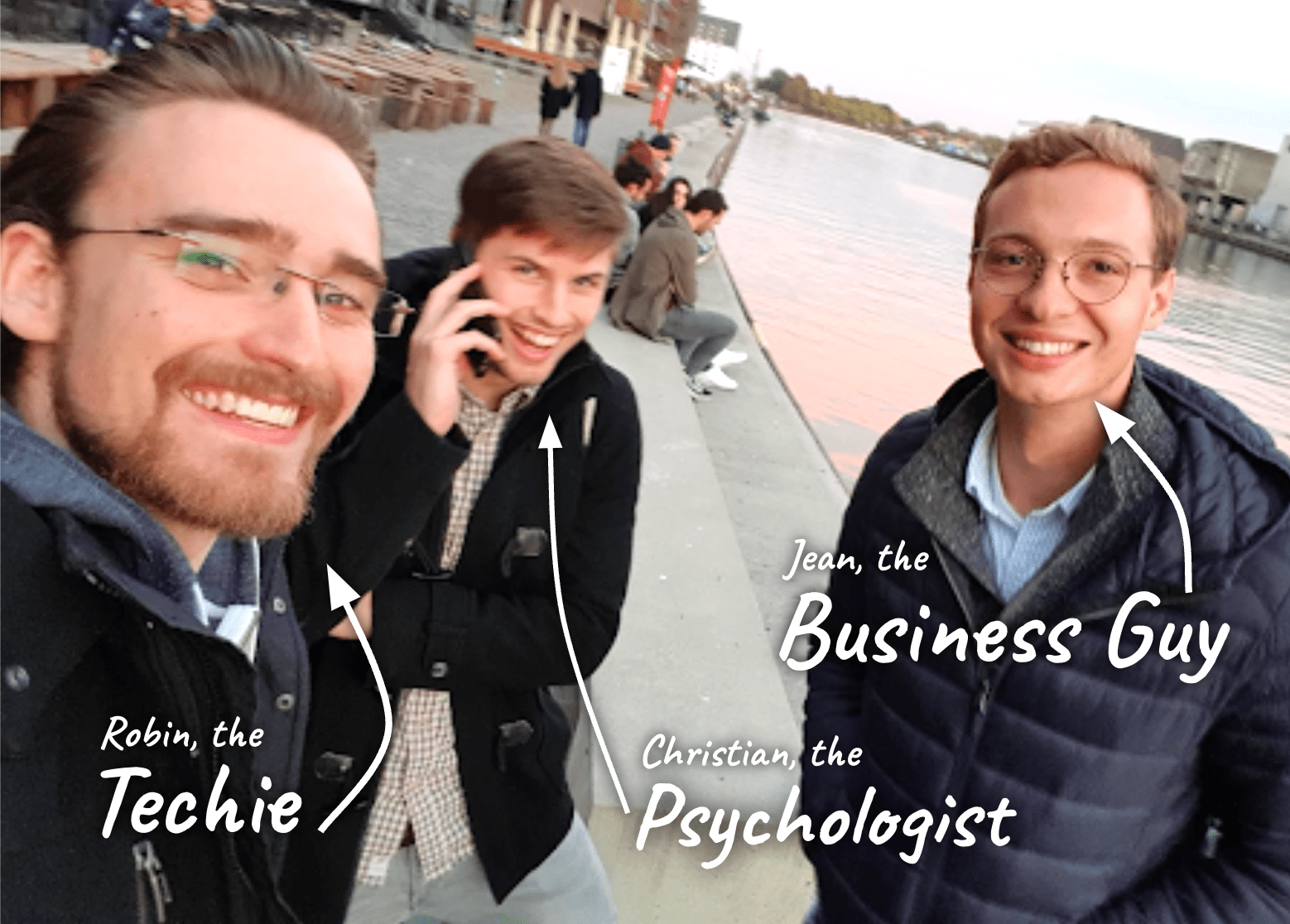
At that time, Jean already had Robin onboard, an extremely competent and fun Software Developer. They got to know each other in their fancy jobs at the Bertelsmann Company.
The three of us were aligned on one thing: If we do this, we do this right. What we don’t want is the pressure of quick monetization.
Thank god, our early advisor, psychologist Prof. Dr. Meinald Thielsch made us aware of this European scholarship for science based startups, EXIST, attentive. We applied for the scholarship - and got it. Now it was our official job to put scientific findings into practice - perfect!
135K € in the account… and no idea
On February 1, 2019, we had €135,000 in the account (or more precisely, available as a budget, according to the terms of the scholarship). And this very clear “problem area” that needed to be solved.
But stop - the problem isn’t that clear at all! What are the underlying causes that need to be solved? Good question. How can we achieve problem-solution fit (or PSF), if we don’t know the exact problems yet?
We did what every good startup does: trying to understand the problem that you want to solve through interviewing hundreds of people. This took place in our first office space, the Founder’s Garage.
Which book would I take with me if I were stranded on a desert island?
‘How to build a boat.’
Steven Wright
This pragmatic answer of Steven here is basically how we approached the complex “starting a startup challenge”. Doing the obvious things first. Being very busy.
Looking back at this time now, I don’t really know why we were so busy. We could have been way more effective. But I guess that is part of our personal development journey, learning step by step.
At some point we were able to give the problem area a clearer name, a pattern we saw in our interviews: the missing “Agile Mindset”.
From my psychological education, I knew it by another name: Missing self-efficacy, which is related to “learned helplessness”: Basically the feeling that you can’t cope with your challenges on your own. According to the motto “My manager has to solve this for me”.
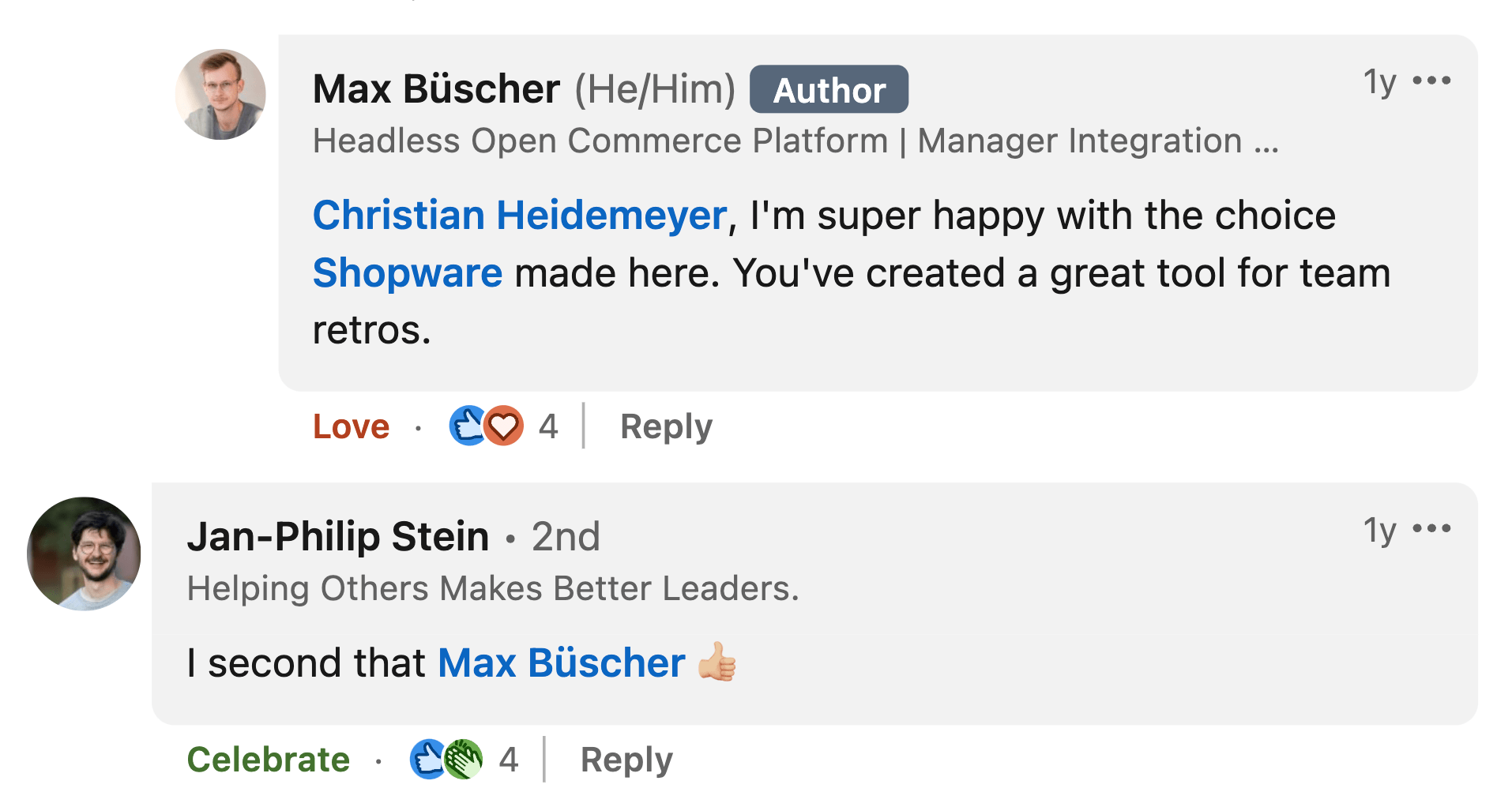
At this point, we also won our first pilot customers (such as Shopware , see screenshot of LinkedIn). We mainly sold consulting services, which enabled us to develop individual features of our software. It was going in the right direction, but…
Time To Market: “…that takes too long!”
The scholarship was limited to 12 months - and so was our budget. After 10 months of the scholarship, we had the first MVP software solution up and running.
But a lot would be needed to make the solution work for customers without extensive training and onboarding efforts. What did we do?
Well, thanks to some early revenue and another, smaller german scholarship called the NRW start-up grant, we were able to continue working. Each founder at least had a monthly salary of 1.450,00€ in the second year. Not too bad!
Over our second year, we generated new learnings about the life of our persona. We understood the market and its pains. And saw clearer and clearer why there is a need for a team development tool like ours.
What did we learn?
Learning 1
How do I know if I’m a good Agile Coach?
These super important new roles - Scrum Master and Agile Coaches - have a problem: To be respected by stakeholders and managers, you have to be able to somehow measure your own performance. But what makes a Scrum Master successful? How do I know if I’m a good Agile Coach?
What is an Agile Coach?
Typically it is a Coach for teams that are working with agile methods and frameworks. A servant leader that knows these frameworks and trains the team in implementing them.
At the same time, those exact same managers are oftentimes one of the biggest reasons for work environments hindering agile transformations.
Some of the IT managers we interviewed put it quite bluntly like this:
To be honest, I consider my Agile Coaches to be “tree huggers”. Of all the managers, they are the hippies. It’s just hard to tell if their work has the benefits it should. From what I hear, some Scrum Masters are like kindergarteners for their team.
IT managers in our interviews
Uh, that hurts. They have such an important role but sometimes are not taken seriously by management.
Given this, there is a need for a more data driven agile coaching process that does not contradict fostering the agile values or the psychological safety in teams). This is how Agile Coaches gain the respect of “old school” managers - sometimes we also call them “waterfall managers”.
And once Scrum Masters and Agile Coaches have this respect, they can work on the mindset of the waterfall managers - which are often one of the central blockers for successful agile transformations.
Implication for Echometer: Have a data driven approach and agile maturity health checks at our tool’s core.
Learning 2
The development of the agile mindset is basically of black box.
For Scrum Masters and Agile Coaches, developing the agile mindset of their team is still a major challenge, a kind of black box. How do employees unlearn “learned helplessness”? How do you create self-efficacy? How do you activate team members so that they participate in the continuous improvement process?
The causes of human behavior lie in psychology. Given this, Agile Coaches need a psychological perspective on the development of the agile mindset.
Implication for Echometer: Use psychology as a weapon, put it at our tool’s core.
Learning 3
Individuals and interactions over processes and tools.
The Agile Manifesto postulates it, and Agile Coaches and Scrum Masters repeat it over and over again: “Individuals and interactions over processes and tools”.
Early on, we heard people reasoning against tools, citing the Agile Manifesto. We heard people say it, and totally agreed with them. But why another retro tool then?
What we had to learn: This sentence doesn’t mean that processes and tools are not important. They simply have to serve and adapt to the people and interactions.
Let me explain it with another favorite quote from our market: “A fool with a tool is still a fool. In German: Ein Dummkopf mit einem Werkzeug ist immer noch ein Dummkopf.”
True! A fool with a great tool remains a fool. But isn’t “Scrum” itself basically a tool? Isn’t a “check-in” in a retrospective also a kind of tool?
Tools have the power to make fools quasi-smarter - as long as the tool clearly guides them. That is, when the fools use it, they must not be able to do anything wrong.
Just for the record: from my experience most of the Agile Coaches and Scrum Masters are actually the opposite of fools, they are really smart.
Implication for Echometer: It has to be the easiest thing in the world to use our psychological nudges - depending on the maturity of the team.
These three learnings are reason enough for another tool. And not for a typical retro tool. The tool, Echometer, needs to go beyond classic retros to really make a lasting positive impact. #Sustainagility
Fundraising - and scaling?
Back then we all did the Scrum Master certification… To get to know our persona, to get a feel for how people are thrown into the deep end - and are suddenly in this new role of servant leader and coach.
The insights gained from that experience allowed us to even more view the challenge from our user’s point of view. We were winning more customers. Still, we were slowly but steadily running out of money by the end of 2020.
As if that wasn’t enough, a competitor from Silicon Valley had raised $8 million from Microsoft Ventures and other investors a few months earlier. That’s not a problem in itself, but let’s just say… psychologically speaking, this gave our startup journey a little spice. If we are David, we had finally found our Goliath.
Perfect time to talk to angel investors! It was thrilling. So much money on the table! And we were very happy to see that some of the first angel investors who commited to an investment - were early customers.

In January 2021, we raised our pre-seed round of around 600k € with well-known angel investors like Stefen Weich, the former CEO of the Unicorn Flaschenpost. Not quite 8 million, but damn. We were still very happy with it: enough financial runway to continue working on our mission!
The next step is obvious: let’s publish the “We are hiring” badge!
“We are hiring”… too fast
And that’s exactly what we did. Sales, marketing, customer success… We hired. Too fast.
I have to add, we did make some progress at the time. We won customers like Toyota, Miele, Volvo, Deutsche Bahn, Bilfinger, DATEV, leading car manufacturers whose names we are not allowed to publish. This is what a user published on LinkedIn published - wow, that feels really good:

So we are developing our tool in the right direction. But, looking at it now, we still had the wrong go-to-market strategy: We used a sales team that actively reached out to our target group and asked them to let us demo our software to them.
This is quite an expensive sales approach that you can only afford if your deals have an average Annual Contract Value (ACV) of 10k € at minimum. Given that our ACV was still significantly lower at that time, it was way too early to hire all these great people to scale the existing processes.
Some painful lessons
Our core learning: Scrum Masters and Agile Coaches don’t want to get sold on a retrospective tool. They simply want to try out tools on their own, deciding if it is good or not.
So there we were, we took a risk that backfired, and we were left with a sales team that wasn’t able to pay for itself, due to no fault of their own. Unfortunately, there was really only one option left: We had to let some people go again, in some cases not even a year after hiring them.
As founders, that’s one of the toughest calls to make and to communicate to the team.
But in our case, something remarkable happened. Every single team member, even the ones who would have to leave us, reacted with sadness, of course, but also with understanding and compassion.
There was no trace of hostility, disappointment, or offense. I’m incredibly proud that we managed to build a team culture that is so open, honest, and allowing for vulnerability, that this was able to happen in this way.
Our key sales guy, Andreas, published this post on LinkedIn: “Goodbye, Echometer”. Hearing “These 18 months have been the best in my long career!” is an honor.

Because as founders, we were of the opinion early on that a company is the “is the machine that builds the machine”. Having committed colleagues who love their work is key to this.
That brings me back to our biggest success so far. It’s simply the fact that, so far on our journey - with all its ups and downs - we have managed to create a very positive experience for both our users and our colleagues.
This might sound trivial, but if you are a founder (or happen to know one) you might realize how hard this is given the pressure to succeed, all odds against you. In our view, a startup’s journey, no matter where it leads, is successful as long as it has a positive impact on customers and employees.

Trying is the first step toward failure.”
– Homer Simpson, The Simpsons
Conclusion: Echometer is not a retro tool, but a tool for modern team development
Homer has my sense of humor and he’s right. But he forgot the second part of this: Failure (and talking about it) is the path to learning, and thus to success. We, as many other Startups, are failing forward.
For example, we are very pleased that our current product focus on “fun and flexibility in the retrospective” is leading to initial success. After seeing our integrated whiteboard, a user recently said Echometer was like “ Miro marrying EasyRetro ”. Nice! #CelebrateTheSmallThings
To conclude, do we really need another retro tool? Let me put it this way: As an Agile Coach or Scrum Master, would you say it is easy to foster the agile mindset in and across teams?
There you go. This is why we are developing Echometer .


