

50 Refreshing 1:1-Meeting Questions to ask Remote Employees
Imagine you’re standing outside under a starry sky. Somewhere in the distance you see a campfire flickering – you know someone is there, but the distance makes it hard to really know how they are.
That’s exactly what remote leadership can feel like: you see each other in video calls, work together, but the distance somehow makes you feel in the dark. One-on-one meetings between a manager and a remote employee should be “campfire moments” where, ideally, both sides can warm up - that is, feel better and have a sense of progress.
That’s why I’ve put together some refreshing questions in this text that you can ask your remote employees for a good conversation.
Whether in a digital or virtual one-on-one meeting, 1-to-1 meetings offer space for feedback and therefore personal development, which is essential in today’s working world. And in this article, I’ll give you good questions that you can use in your weekly, bi-weekly or monthly remote one-on-one meetings with your direct reports to have good conversations.
First of all: If you’re still unsure about what good one-on-one meetings (whether virtual or on-site) look like, take a look at our guide: The guide with 6 tips for successful one-on-one meetings.
One-on-One Meeting Questions you need to ask remote employees as a Manager | Virtual Leadership at a distance
6 Practical Tips for your Remote One-on-One Meetings
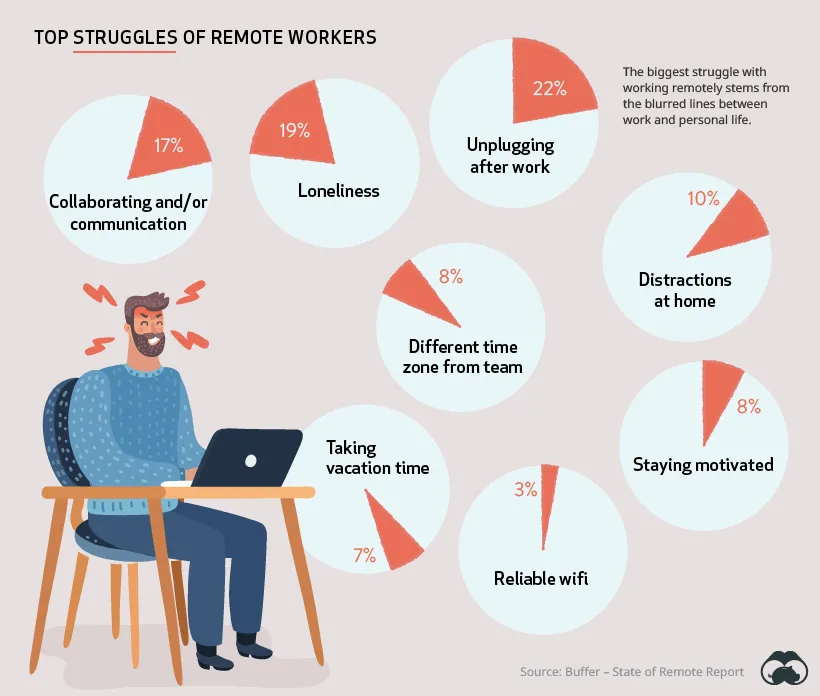
According to the Harvard Business Review, almost half of employees rate their one-on-one meetings as suboptimal (HBR, 2022). And now imagine doing them remotely too - that probably doesn’t make it any easier.
As you can see in the picture, there are many additional challenges in a remote situation when leading at a distance. To help you overcome these, I would like to give you a few practical tips before we move on to our list of questions for your Remote Direct Reports.
1. Use the camera “weather report” 🌤️
Instead of starting with “How are you?” (which is often followed by an unmotivated “Fine”), ask: “How is your inner weather today? Sunny, cloudy or stormy?” This lightens the mood, gives room for real emotions and helps to better assess the dynamics of the conversation.
2. Change of location for more clarity 🚶♂️
Consider whether a location other than your regular workplace might be possible for your one-on-one meeting. Because different locations help you to perceive the 1:1 more consciously and to get out of the everyday tunnel mentally. At Echometer, we also conduct one-on-one meetings that are less operational and more strategic or for reflection, during walk-and-talk phone calls - these are very creative meetings!
3. “The one big topic” instead of too much small stuff 🎯
Instead of working through a checklist, ask: “If you could only take or clarify one thing today – what would it be?” This will take you straight to the most important point.
4. “If I were to disappear today…?” 👀
Ask the question: “If I were suddenly gone as a manager for a month – what would you miss, what would you do differently? What would you want to know beforehand?” This will also help you to focus on the most important points with a new perspective.
5. Try “chat mode” for introverted employees 💬
If you have very shy employees, the following could be worth an experiment: You have your 1:1 conversation as a live chat. Topics are addressed in writing with fewer barriers. You can think about questions for longer and without time pressure. It’s worth a try.

“I like the employee, but they aren't performing as desired. How can I address this in 1:1s?”
Solve this challenge
"Sometimes I’m not sure if I was too harsh - or too soft - in my 1:1s to be effective."
Solve this challenge
"I can’t identify patterns or trends across my 1:1s. Everything feels isolated."
Solve this challenge6. “Guess your week” game 🎭
Start with: “Let me guess how your week felt…” Then name three options (“You were super productive,” “Everything was chaotic,” “You had a low”). This provides a playful entry and opens the conversation. Of course, you can also reverse it and have your employee guess your week - maybe you even provide answer options.
7. End the meeting with a mini preview 🎬
Instead of “See you next week”, ask: “What’s the one thing you’re looking forward to until the next 1:1?” This helps you to leave the meeting with a positive feeling.
So, these tips should make your one-on-one meeting much easier for you as a supervisor or boss. Now let’s move on to our list of questions.
One-on-One Meeting Questions you need to ask remote employees as a Manager | Virtual Leadership at a distance
Good standard one-on-one Meeting Questions
Managers of remote employees in particular have a greater obligation to ask about the well-being of their direct reports. Because in everyday life, there are naturally far fewer cues for the well-being of your team members if you don’t regularly bump into them in person.
I have put together some questions for this use case and other general areas here.

✅ General One-on-One Meeting Questions
- How are you really doing right now?
- How are you doing right now, on a scale of one (very bad) to ten (very good)?
- How focused are you at the moment on a scale of 1 to 10? And why?
- What's on your mind right now?
- What's holding you back from your work right now?
- What's going well for you right now?
- What's not going so well right now?
One-on-One Meeting Questions you need to ask remote employees as a Manager | Virtual Leadership at a distance
Refreshing 1:1 Meeting Questions to ask Remote Employees
In addition to the more general areas above, there are some other topics that are particularly relevant for remote employees.
These include, for example, the topics of communication, tools or work-life balance. I also have some suggested questions for you.
🤖 Remote 1-on-1 Questions about Resources
- How satisfied are you with your home office setup?
- What are the moments when you feel lost or disorganized?
- Are there any technical or ergonomic challenges that bother you?
- Which tools or processes could make your work more efficient?
- Are there any processes that you find unnecessarily complicated?
- Which team rituals or formats do you miss in our remote setup?
- Are there any team events or activities you would like to try?
- What resources or support do you need to work more productively?
One-on-One Meeting Questions you need to ask remote employees as a Manager | Virtual Leadership at a distance
One-on-One meeting questions for Remote Employees on the topic of Soft Skills
As a supervisor, you are particularly dependent on your employees having the necessary soft skills to compensate for the lack of personal contact, especially when managing remotely.
Soft skills can also be reflected on and improved by asking your remote employees the right questions. Here are some examples.
🫣 1 on 1 Questions about Soft Skills - Reflection
- When have you thought about asking a question in our team (meeting) but didn't? What stopped you?
- What would you do differently if you had 100% confidence in yourself?
- How would your life change if you had 20% more self-confidence?
- When was the last time you felt like you made a mistake with something? What would be a constructive view of this "mistake"?
- When was the last time you needed help at work? When did you actually ask colleagues for help? How did you ask and how did they react?
- Reflect: What are good reasons to say "no" when someone asks you to do something?
- Where do you see your team: How are speaking turns distributed? Where do you see yourself: What role do you play, depending on the meeting?
- What efforts can you make in the near future to improve your relationships with colleagues? Which improvements would most positively impact your work life?
One-on-One Meeting Questions you need to ask remote employees as a Manager | Virtual Leadership at a distance
9 Health survey questions as interactive remote 1:1 Meeting
After interviewing around 100 managers about their 1-to-1 meetings over the last few months, I’ve noticed a pattern.
Many supervisors occasionally incorporate small surveys into their one-on-one meetings. This means that they simply go through a few questions in a relaxed manner and ask their staff a) whether he or she agrees with a statement (for example from 1 to 7) and then b) why he or she answered in this way.
They expect the following from these micro-surveys in 1:1s:
- More variety and engagement in 1-to-1 conversations
- Taking on new perspectives
- Measurability of (soft) KPIs such as satisfaction over time
And of course, you can also use this idea particularly well in your one-to-one meetings with remote employees. I have put together five statements for you here that focus on reflecting important preconditions for every successful employee.
You can also download this template as a Doc, but even better is the following: In our one-on-one meeting software, we have an integrated tool that makes the results visible as a metric over time and gives you tips with an AI assistant - feel free to take a look without logging in via the button below.
⁉️ Mood check (agreement from 1-7): Personal development
- "My work tasks generally make very rapid progress, even if external feedback is necessary."
- "When I observe suboptimal behavior, I know how to constructively point it out to colleagues."
- "I receive constructive Feedback on both my work and my personal development."
- "I see an attractive career path ahead of me in the company." #Growth
- "In recent weeks, I have very often been able to use my strengths at work."
This is what this survey looks like in Echometer:
As you can see, the statements address key preconditions of staff that feels happy.
Another prerequisite for healthy, productive employees is, of course, a good manager. Yes, I’m talking about you here.
And of course there are also statements that you can take with you to your remote one-on-one meeting. Specifically, here are 4 behavioral anchors that you can regularly reflect on in a weekly or monthly one-to-one meeting with your employee, for example.
⁉️ Mood check (agreement from 1-7): Leadership quality
- "I am really satisfied with my team leader." #JobSatisfaction
- "My team leader regularly zooms out to explain the overarching team goals, strategy and vision."
- "My team leader questions things in a constructive way." #Feedback #Leadership
- "My team leader sets an example of what he expects from us as a team." #Leadership
This is what this survey looks like in Echometer:
And, can you hardly wait to ask these questions in your one-on-one meeting? Very good, I’m glad.
If you would like more creative input, I can recommend our corresponding article: 129 Good One-on-One Meeting Questions (by a Psychologist) .
And if you’re interested in learning more about how to lead remote teams well, take a look at this video: The first video of a remote leadership training course for managers of virtual teams.
One-on-One Meeting Questions you need to ask remote employees as a Manager | Virtual Leadership at a distance
15 templates for one-on-one meetings (as Doc, PDF etc.)
You’ve probably already guessed it. Of course, there are many more questions and entire templates for one-on-one meetings that you will need sooner or later.
For example, I talk about questions and templates for your one-on-one meeting on salary, your conversation with a difficult employee or with a completely new employee.
We have additional templates for all of these use cases, which you can find in this article: 15 Free Proven One-on-one Meeting Templates to Edit & Print

One-on-One Meeting Questions you need to ask remote employees as a Manager | Virtual Leadership at a distance
Conclusion: Good Employee Questions in remote One-on-One Meetings
The success of one-on-one meetings is best measured in the long term: Is an employee consistently satisfied and productive, is he or she developing?
Routine sometimes creeps in, especially with many conversations, and the quality of one-on-one meetings decreases. That’s exactly why I wrote this text: Hopefully you have been inspired by the various questions for good appraisal interviews with remote employees.
But you still mustn’t forget one piece of wisdom: there are countless questions you can ask - but the most important thing is that you tailor the conversation individually to your employee.
Our AI meeting assistant for one-on-one meetings can also help you with this. If you want to find out more about it, take a look at our website: The best 1-on-1 meeting software .
"Many team members are afraid to speak up!"
Solve this challenge "We discover too many unexpected issues & bugs at a late stage!"
Solve this challenge "Why does it sometimes take me hours to prepare a simple retrospective?"
Solve this challenge


