

Retrospective in Scrum and beyond
What is a Retrospective?
A retrospective is a meeting routine in which you regularly reflect on how the team is working together in order to derive continuous improvements.
Especially with iterative (“agile”) working methods such as Scrum, Kanban or OKRs Retrospectives (or “scrum retrospectives”) are used as a central tool for continuous development and improvement in teams.
While retros have just caught on in software development, there are no limits to the scope of retrospectives also outside of IT, as every team can benefit from this regular reflection process!
Goal and purpose of a retrospective
The goal of a retro is to collect perspectives and experience of all participants to
- share and align different opinions,
- generate new insights, and
- define measures for future improvements.
Not every retrospective needs to result in a specific action item. Simply creating the space to align perspectives within the team is often an added value, creating trust among each other and encouraging team development.
Retrospectives also improve Psychological safety in teams , which has been proven to be crucial to long-term team success.
Retrospectives in Scrum and other use cases
Retrospectives in the Scrum framework
In the Scrum framework retrospectives are planned as an integral part of every Scrum sprint. Scrum retrospectives are specifically about reflecting on the work of the past sprint together.
In Scrum, the retrospective takes place at the very end of each sprint cycle:
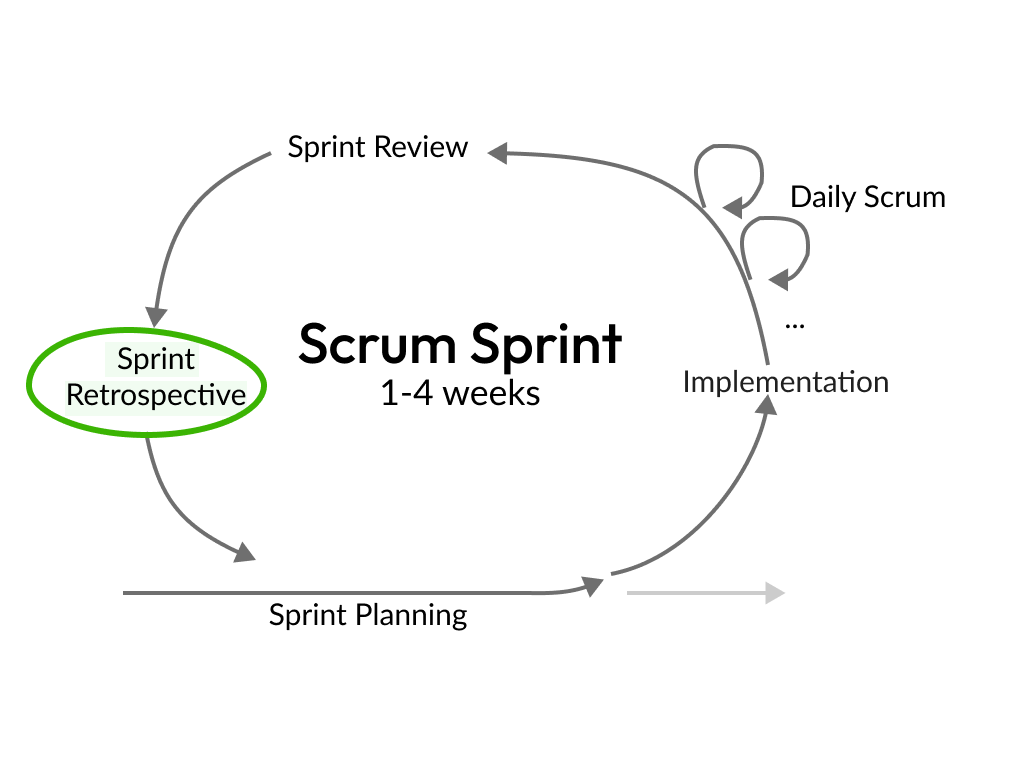

A cycle in Scrum usually lasts between one week and one month. Accordingly, retrospectives in Scrum teams take place weekly to at least monthly.
Retrospectives that follow the Scrum framework and focus on a Scrum team are referred to as scrum retrospectives. The focus of these Scrum retros is often on the application of the Scrum framework.
However, retrospectives are not tied to Scrum, as we will see in the next section.
Team level retrospectives
Analogous to Scrum retrospectives, there are also, for example OKR retrospectives and Kanban retrospectives, in which the implementation of the respective framework is reflected in each iteration.
Since teams do not usually do separate retrospectives for each framework, retrospectives that relate to team collaboration in general are often referred to as a “team retrospective.”
Cross-team retrospectives
Retrospectives do not necessarily always have to take place at team level. Also agile frameworks incorporate retrospectives such as SAFe retrospectives, LeSS overall retrospectives or “Scrum of Scrums” retrospectives, which take place on a cross-team level to reflect the interfaces and dependencies between teams as well as organizational framework conditions.
In these cross-team retrospectives, the individual teams often collect their topics in advance and send individual team members to bring their topics to the cross-team level.
Prerequisites for retrospectives
Focus of a retrospective
According to the original use cases of a retrospective, it is important to communicate the focus of a retrospective in advance. This way, all participants know which topics they can bring into this retrospective.
Participants of a Retrospective
In addition, it is important that as many of those affected as possible also participate in the retrospective - in the case of cross-team retrospectives, at least one representative per team. This ensures that as many impressions as possible can be contributed and discussed as unfiltered as possible.
Attention: The larger a team, the more challenging the moderation. Teams should generally not be much larger than 10 participants. If that’s not possible, here are a few Tips for moderating retrospectives in large teams .
Psychological safety in retrospectives
In order for all perspectives and perceptions to be included, “Psychological safety” in the team / Number of participants is enormously important. If psychological safety, including the ability to openly raise critical issues, is limited among the participants, it is a good idea to set up an anonymous feedback channel. This makes it easier to address issues. The discussion of anonymously submitted topics is then of course no longer anonymous.
If this requirement is not yet met, first learn like you Create psychological security in the team can.
Frequency of retrospectives
Finally, retrospectives are characterized by the fact that they take place regularly. Formats like “ Lessons learned workshops %E2%80%9D or “Post Mortem Analyses” are often long appointments that are carried out at certain milestones or project completions. And this is exactly the difference to retrospectives.
Retrospectives should be short and frequent. In agile teams, a rhythm of weekly to monthly frequency has proven effective. Retrospective frequencies beyond 6 or 8 weeks are rather unusual and should be viewed critically regarding their effectiveness.
Time scope of a retrospective
Depending on frequency, retrospectives can last between 45-90 minutes. If the frequency is longer, for example monthly, one would tend to use 90 minutes. Weekly retrospectives can also be 45 or 60 minutes.
The following applies to retrospectives: Better “shorter and more frequent” than “longer and less frequent”. Short frequencies create fast learning loops, so that teams can reflect on the effectiveness of their measures defined in past retrospectives as early as possible and adapt them if necessary ( Tips for good measures from retrospectives ). Especially with practice of the format, it will then also be easier to better observe the time frame (Tips for Timeboxing in Retrospectives), or even to shorten it.
conducting retrospectives,
Steps of a retrospective
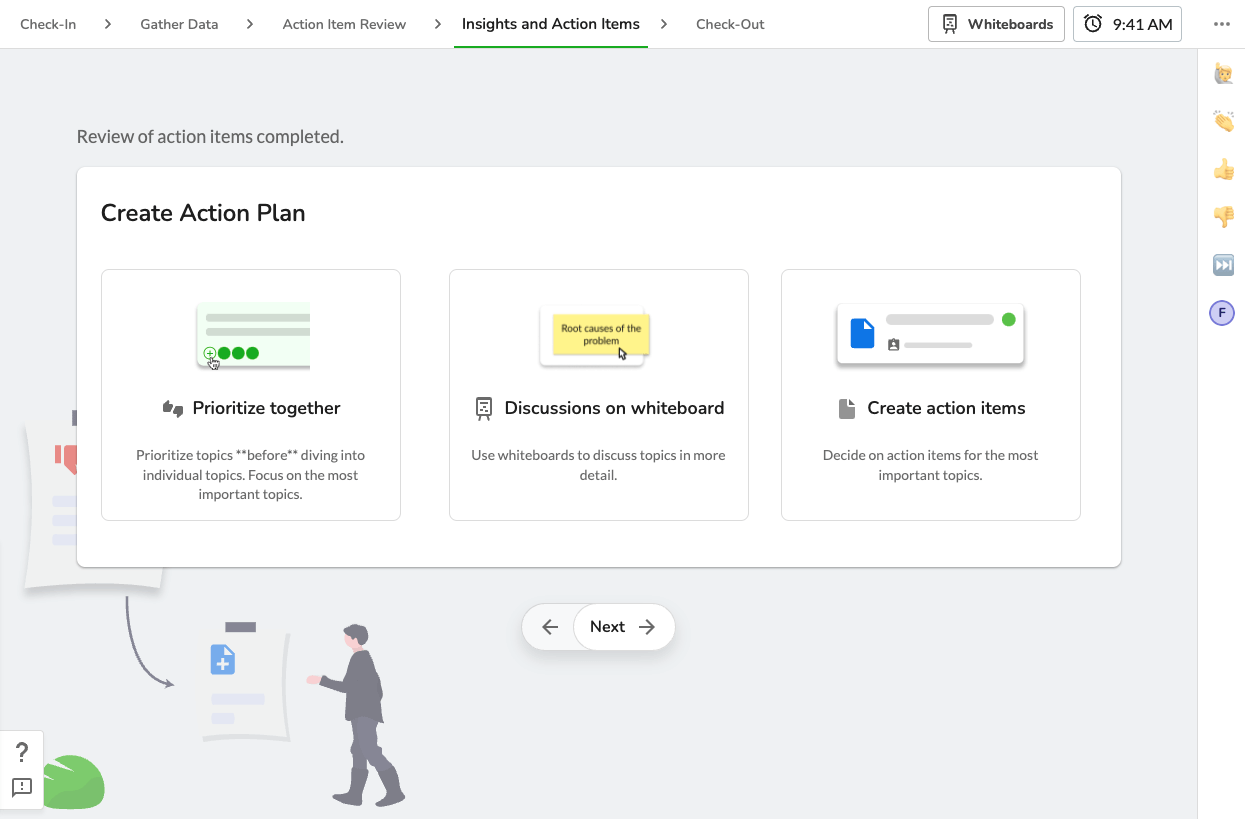
Classically, one speaks of the 5 phases of a retrospective :
- Set the stage (Check-in)
- Collect data & feedback
- Generating insights
- Action items
- Conclusion (Check-out)
To better understand how these steps of a retrospective work, we recommend a look at the “Double Diamond” model .

Key questions in a retrospective
To diversify retrospectives, facilitators often vary the format with different metaphors. At the core, however, the questions always revolve around:
- What went well?
- What did not go so well?
- How can we improve better next time?
One of the popular metaphors for these core questions is, for example, the Sailboat Retrospective.
Moderation of a retrospective
The moderation of a retrospective should be as neutral as possible. Therefore, it is optimal if a neutral person (for example, an Agile coach) can conduct it.
If you do not have a team coach, you can either commission an external person to moderate the retrospective or, as a first step, you can act as the team’s leader and take over the moderation. However, the manager should enable the team as quickly as possible to conduct retrospectives without the manager (or at least without their moderation).
If there is no neutral moderator in the long term, it is worthwhile to simply rotate the moderation role within the team.
No matter if you are a newcomer or an experienced moderator: In this eBook, we have summarized the best practices for moderating retrospectives for you:

Conclusion: Retrospectives are not only for Scrum teams
As you have seen, retrospectives are a key tool for building high performing teams, which can also be established in any team with a little practice.
So if your team is not yet working with retrospectives, try it out over 3 months, for example.
Tip: After each retrospective, ask the team about the “Return on Time Invest” (ROTI):
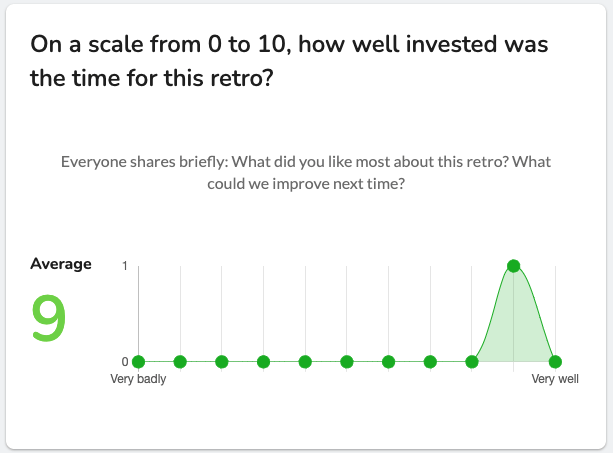

Using the ROTI, you immediately get a picture of how the format is received in your team. After three iterations at the latest, you should reach an average value of around 8 / 10. If not, it’s best to check out our eBook: 20+ tips for facilitating retrospectives .
Do you like it data-driven? Then I recommend a look at ours Analysis of 30,000 retrospectives !


