

5 phases of a retrospective alone are not enough: the Double Diamond model
Many teams frequently change the format and design of the phases of their retrospective to ensure variety and stimulate the creativity of team members. But what is the decisive factor for a successful retrospective in the end? The “Double Diamond” model offers a profitable perspective on the phases of a retrospective.
If your team is unsatisfied with the retrospectives, the model could be an exciting approach to improve the structure, time efficiency and above all the results of your retro.
Retrospectives & the Double Diamond 💎
The core of successful retrospectives
There are thousands creative ideas with which metaphors one can carry out retrospectives: From the Starfish- until the Sailboat-Method. While these “themes” can be a great inspiration to add variety to the retrospective and help team members come up with new ideas and change perspective, that alone is not enough.
Their effectiveness depends to a large extent on one aspect that all successful retrospectives have in common. This brings us back to the “Double Diamond”.
Retrospectives & the Double Diamond 💎
The Double Diamond model and the phases of a retrospective
The model originated in 1996 Divergence-Convergence model, developed by Béla H. Bánáthy, a professor at UC Berkeley and San Jose State University. The model essentially differentiates between “diverging thinking” and “merging thinking” and has especially been seen in the design thinking community user-oriented design process established.
In the diagram, the Divergence-Convergence model looks like two diamonds (hence the name “Double Diamond”):
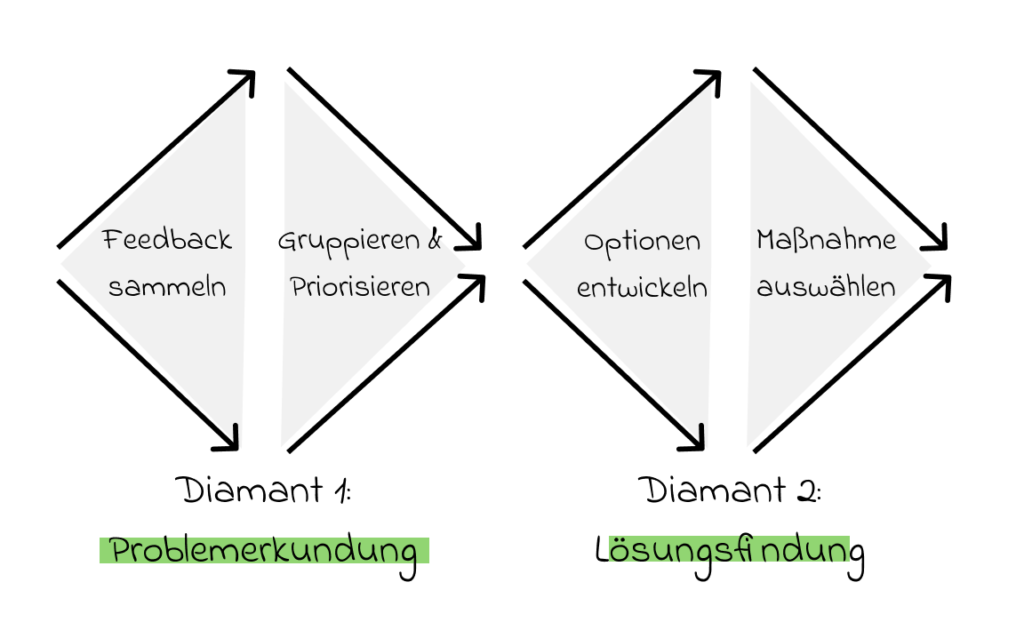
Retrospective Phases & the Double Diamond 💎
What does the Double-Diamond model mean for the phases of a retrospective?
Exactly this perspective of “diverging” and “converging” can be wonderfully transferred to retrospectives. Because here, too, the aim is to collect as many perspectives as possible in the “gathering data” phase by thinking apart (diverging), which are then brought together again in the “Generate insights” phase (converging). The separation of these two steps is particularly important:
- If you do not make sure that there is enough space for diverging thinking, important perspectives may be lost. Or problems that are not mentioned at the beginning are ignored.
- If you neglect to merge and prioritize, too many individual problems tend to remain. Then you tend to derive measures for everything that leads to that Time management in the retro cannot be met.
While the first half of the 4-phase Double Diamond model is in the classic 5 phases of a retro is taken into account, the second diamond (i.e. the second half) is often neglected both in the phase model and in practice.
The fourth phase of the retrospective is called “Decide what to do” and not “Discover what could be done” (which would be better from the point of view of the Double Diamond model). The problem with “Decide what to do” is that the “Solution Space” is not explored sufficiently and one is tempted by the additional pressure of the Timebox to hold onto the first solution. If time permits, one should deliberately differentiate between “Discover what could be done” (diverging) and “Decide what to do” (converging).
Retrospective Phases & the Double Diamond 💎
Tips for your next retrospective
So much for the theory. What can you take with you for practice? Here are my tips for using the “Double Diamond” model in the respective phases of your next retrospective:
1. No action in the first half
For some teams it has become an unpleasant habit to want to record any measures that are thrown into the room directly in the “gathering data” phase.
The consequence: The dynamics necessary for divergent thinking are disrupted and it becomes more difficult to gather new perspectives. Instead, try to consciously note ideas for measures as ideas - not as the final measure of the retro.
2.Drill deeper into problems (opening the first diamond)
Feedback on sticky notes is often short and therefore requires interpretation. If feedback is not entirely clear, or seems unusual, actively ask clarifying questions - better one question too many than one too few. Every now and then you will notice that your initial understanding of a feedback changes.
Another advantage: Your questions will probably also help other team members to sharpen their understanding.
3. Decide what is really important (closing the first diamond)
Depending on the size of the team, the number of feedbacks can be overwhelming. Before you start to derive measures, you have to make a decision about which topics are worth your own timebox for deriving measures.
The second diamond should only be opened when it is clear which topics are sensibly discussed with the entire team.
4. Explore the solution space (opening the second diamond)
Don’t be tempted to simply push the first solution that comes to mind. Here’s a rule of thumb: For each key topic, take at least the time to have considered 1 to 2 alternative solutions. It will not be uncommon for one of the alternative solutions to be preferred in the end - then you are welcome to think of Echometer :-)
5. Only measures of great importance
It is not difficult to simply record 10 measures from a retrospective. It is difficult to record the 1 to 3 correct measures. Nobody can remember 10 measures and nobody has the motivation to follow up so many measures. If you deduce 10 measures, 5 of them will probably fall completely under the table, 3 will have little or no influence and only 2 will be remembered and will help the team.
The trick is to focus on things that really have a noticeable impact on all team members.
By the way, the Echometer tool, which is specially developed to carry out really value-adding retrospectives, can also help. You can find more information in the box below.
Retrospectives are a standard format in your team or should it be? Then it might make sense to use a tool specifically designed for this purpose, which was developed with exactly this model in mind. Here you can simply try out the Good/Bad retro:
Open Retrospective NowThere are also testimonials from Agile Coaches and Team Leads: Read field report
Retrospective Phases & the Double Diamond 💎
Conclusion: 2 diamonds as phases of a retrospective
For me, the model was a great help in understanding what makes a successful retro. Therefore, I hope that the “Double Diamond” will offer you a common thread with all the variety in your retrospectives, with which you will bring every retro to success.

"Many team members are afraid to speak up!"
Solve this challenge
"We discover too many unexpected issues & bugs at a late stage!"
Solve this challenge
"Why does it sometimes take me hours to prepare a simple retrospective?"
Solve this challenge


