

7 Best Retrospective Tools for Easy & Fun Retros in 2025
All right, for the impatient among you who don’t want the complete comparison of the 7 best retro board software tools: You can start a retro directly for free in our retro software or run your team’s retrospective online and see for yourself by clicking here:
For everyone else, I made an in depth comparison of the best team retrospective board tools to facilitate retros online below. Why do I think they are the best free retrospective software tools? I tried to be objective and simply looked at their website traffic. Find more on this below.
The 7 Best Retrospective Software Tools for Your Teams Retro
We will compare the following best retrospective software tools to do retros online:
Table: The 7 best retro tools compared
Here is a short overview of the 7 tools and their functions:
| Evaluation criteria | Echometer | Retrium Board | Team Retro | FunRetro (formerly EasyRetro) | Parabol Board | Kollabe |
|---|---|---|---|---|---|---|
| Interactive online retrospectives | Yes | Yes | Yes | Yes | Yes | Yes |
| Automatically generated retro summaries | Yes | Yes | Yes | Yes | Yes | Yes |
| Support of facilitator (e.g. automated check-ins) | Yes | Yes | Partially | No | Partially | Yes |
| Templates for every level of team maturity | Yes | Partially | Partially | No | No | Partially |
| Continuous tracking of action items</br> (retro to retro) | Yes | Partially | Partially | No | Yes | Yes |
| Team development measured over time | Yes | Partially | Yes | No | No | No |
| Collecting feedback before retros (optional) | Yes | No | No | No | Yes | No |
| Organizational Health Checks | Yes | No | No | No | No | No |
| Health Check Item Pool with Nudges (Food for thought) | Yes | No | No | No | No | No |
| Support for mobile devices </br>(for on-site or hybrid retros) | Yes | No | No | No | No | No |
| Integrated Online-Whiteboard | Yes | No | No | No | No | No |
| Data protection (developed and hosted in Germany) | Yes | No | No | No | No | No |
| Free version (after trial) | Yes | No | No | Yes | Yes | Yes |
The 7 best retro tools in detail
Tool No. 1
Echometer: Mindset Retros

Echometer Review on Capterra: ⭐️⭐️⭐️⭐️☆ (4.5/5)
Brief introduction Echometer
Many Scrum Masters & Engineering Managers are going around in circles. They fix superficial symptoms. It’s time to use psychology and address the mindset directly - with the Echometer retrospective software.
Echometer website: https://echometerapp.com/
Echometer
Feature overview
Core features
| Features to foster outputs | Features to foster outcomes |
|---|---|
| ☑️ Action item Support & Tracking | ☑️ ROTI Measurement |
| ☑️ Flexible whiteboard or similar | ☑️ Team Health Check’s |
| ☑️ Various retro methods | ☑️ Team Health Templates |
| ☑️ Support of facilitator | |
| ☑️ Effective timer | |
| ☑️ Optional anonymity | |
| ⚠️ Intuitive UX et attractive design |
More screenshots Echometer
More screenshots Echometer
Whiteboard Check-In

Health Check visualization

Health Check Items

Templates by maturity level

Cross-Team Heatmap & Radar

Cross-Team Overview

Two more quick hints regarding Echometer:
- If you are looking for a free retrospective tool without login are looking for, or an online retrospective tool without registration, then Echometer is the right choice. You can simply look around in the entire retro without registering. If you yourself are logged in in a retro, you can invite colleagues without them having to log in - so it’s also a Retrospective tool without login.
- Echometer has an integration into Jira. So if you are looking for a retrospective tool in Jira, our tool might be something for you.
Echometer
Pro & Contra
| ☀️ Pro ☀️ | 🌧 Cons 🌧 |
|---|---|
| 👍 All central features | 💔 Prescribes the structure of the retrospective |
| 👍 Extensive analysis options for data-driven work | 💔 Learning curve due to high functional depth |
| 👍 Even cross-team health checks possible | |
| 👍 Psychologically sound methods (effect on retro outcomes) |
Echometer
Prices & Access
- Free trial: 21 days
- Free version (after the free trial): Yes
- Basic price (after the free trial): From €29 per team per month (see link below for possible changes to the pricing model)
You can find the entire pricing model here: Echometer Pricing .
In summary, Echometer is easy to use for IT team leaders (whether Engineering Manager, Scrum Master, Agile Coaches, Product Owner, or other retrospective moderators). And it even optionally offers some “premium features” for IT managers in an environment for ” Agile at scale ” (see screenshots above).
Simply select a retro method to open your first retro now and optionally invite your agile team to our Sprint Retro App via link:




Echometer is the right choice for you if you want to develop individual teams and organizations at all levels. It offers you and your team a continuous Health Check of the team’s maturity level, makes successes of your agile transformation visible (as a Team Radar online tool) and is one of the few tools with an integrated online whiteboard for your retrospective. With this in mind and given the comparison here, Echometer is probably the best retrospective board software tool on the market.
By the way, in the following video, a Tech Lead, an Echometer customer, explains his 5 favorite features of the Echometer retro tool. Spoiler: He was positively “shocked”. 😄
Tool No. 2
Teamretro: Easy retros

Team Retro review on Capterra: ⭐️⭐️⭐️⭐️⭐️ (4.8/5)
Brief introduction TeamRetro
TeamRetro is an Enterprise Online Retrospective Tool for Remote Teams. Our guided retrospective methods ensure that your retrospectives are worthwhile - every time.
Team retro website: https://www.teamretro.com/
Teamretro
Feature overview
Core features
| Features to foster outputs | Features to foster outcomes |
|---|---|
| ☑️ Action item Support & Tracking | ⚠️ ROTI metric |
| ⚠️ Flexible whiteboard or similar | ☑️ Team Health Check’s |
| ☑️ Various retro methods | ⚠️ Team Health Templates |
| ⚠️ Support for moderation | |
| ☑️ Effective timer | |
| ☑️ Optional anonymity | |
| ⚠️ Intuitive UX et attractive design |
More screenshots Teamretro
More screenshots Teamretro
Retro Summary

Retro Tool Board

Retro Preparation

Teamretro
Pro & Contra
| ☀️ Pro ☀️ | 🌧 Cons 🌧 |
|---|---|
| 👍 Long list of features | 💔 One of many GroupMap products - accordingly, no development focus |
| 👍 Relevant integrations | 💔 No clear unique selling proposition |
| 👍 Business API | 💔 No “forever free” version |
Teamretro
Prices & Access
- Free trial: 30 days
- Free version (after the free trial): No
- Basic price (after the free trial): Beginning at €25/team/month
Here you can find the whole pricing model: Team retro pricing (English). And you can try it out directly via this link: Free Trial. There is also a detailed comparison here: Echometer as TeamRetro alternative .
Teamretro
Conclusion & Tips
If you look at this analysis holistically, this tool deserves to be called one of the best retro tools for remote teams. You can read here who else made it onto the list: The best retro tools for remote teams . It is not only an anonymous retrospective tool, but also has the ROTI functionality (More information on: Free anonymous retrospective tool ).
I believe that the quality of retrospectives is already an indication of the maturity of teams. Against this background the ROTI (Return on time invest) score is basically also that: An agile KPI . And one that you should consider when it comes to: Measuring agile maturity .
If you would like to learn more about why I believe this, take a look at my post “ 7 tips for teams with retro fatigue ”. “Retro fatigue” means: The team signals that it does not consider the sprint retrospective to be necessary. What can a Scrum Master do about this? This is what this text is about.
Excuse the digression. I just wanted to say: I think it’s very good that the Teamretro Retro Meeting Tool also offers this function of measuring the ROTI score (More on: Retrospective Meeting Tool ). And it is also a Team Radar Online Tool - #ILike. Based on the criteria above, however, Echometer is generally considered the better Retro software than TeamRetro. Now let’s move on to the next free agile retrospective tool that helps conduct retrospectives online.
Tool No. 3
Easyretro: Remote Collaboration

Easyretro.io (formerly FunRetro) Review on Capterra: ⭐️⭐️⭐️⭐️✨ (4.6/5)
Brief introduction EasyRetro
Improve with fun Sprint Retrospectives: Collaborate with your remote team and improve your work with a simple, intuitive and beautiful tool
Easyretro.io (formerly FunRetro) website: https://easyretro.io/
Easyretro io (formerly FunRetro)
Feature overview
Core features
| Features to foster outputs | Features to foster outcomes |
|---|---|
| ⚠️ Action item Support & Tracking | ❌ ROTI metric |
| ⚠️ Flexible whiteboard or similar | ❌ Team Health Check’s |
| ☑️ Various retro methods | ❌ Team Health Templates |
| ❌ Support of facilitator | |
| ☑️ Effective timer | |
| ☑️ Optional anonymity | |
| ⚠️ Intuitive UX et attractive design |
More screenshots Easyretro
More screenshots Easyretro
Retro Board

Tool Formats

Settings in preparation

Easyretro io (formerly FunRetro)
Pro & Contra
| ☀️ Pro ☀️ | 🌧 Cons 🌧 |
|---|---|
| 👍 Long list of retro methods | 💔 None of the features to promote retro outcomes (see above) |
| 👍 Relevant integrations | 💔 Graphically not very appealing |
| 💔 Although it’s called “EasyRetro,” unfortunately not quite as intuitive UX |
Easyretro io (formerly FunRetro)
Prices & Access
- Free trial: 7 days
- Free version (after free trial): Yes, incl. 3 public retro boards
- Basic price (after free trial): Beginning at €26/team/month
Here you will find the entire pricing model and access to the free trial: Easyretro.io Pricing Model (English). I also compare it in detail with Echometer on this page: EasyRetro vs. Echometer.
Easyretro io (formerly FunRetro)
Conclusion & Tips
In light of these features, Easyretro is a fundamentally good and functional free retrospective tool for distributed Scrum teams.
If you would like to learn more about the pricing of Easyretro or Funretro, the anonymity feature or their retro board etc., just take a look at their website. In any case, it is one of the few free tools for anonymous retrospectives. We have put together a compilation on this: Free tools for anonymous retrospectives .
Regardless of how you conduct the agile retrospective online and which retrospective tool you choose, you should consider the following: The 5 phases of a Retrospective . Each of the 5 phases, including check-in and check-out, has its justification and should be part of an online retro.
Did you know this exists: The sixth phase of a Retrospective ? It is a phase that is often missing. Basically, it’s about taking time for something essential in every retro: The development really good measures .
In summary, based on the criteria above, Echometer is generally considered the better retro software than EasyRetro. Okay, let’s move on to the next one in our list of the best free retrospective tools (Scrum).
Tool No. 4
Metro Retro: Engaging retros

Metro Retro Review on Capterra: ⭐️⭐️⭐️⭐️☆ (4.0/5)
Brief introduction Metro Retro
Metro Retro enables teams working in different locations to conduct productive, engaging and entertaining retrospectives.
Metro Retro website: https://metroretro.io/
Metro Retro
Feature overview
Core features
| Features to foster outputs | Features to foster outcomes |
|---|---|
| ❌ Action item Support & Tracking | ❌ ROTI metric |
| ☑️ Flexible whiteboard or similar | ❌ Team Health Check’s |
| ☑️ Various retro methods | ❌ Team Health Templates |
| ⚠️ Support for moderation | |
| ☑️ Effective timer | |
| ☑️ Optional anonymity | |
| ☑️ Intuitive UX & attractive design |
More screenshots Metro Retro
More screenshots Metro Retro
Methods in preparation

Metro Retro
Pro & Contra
| ☀️ Pro ☀️ | 🌧 Contra 🌧 |
| ----------------------------------- | |
|---|---|
| 👍 Partly pretty retro methods | 💔 None of the features to promote retro outcomes (see above) |
| 👍 Very flexible whiteboard | 💔 Further development announced a long time ago, but has not yet been implemented (only 1-2 |
| Software developers behind it) |
Metro Retro
Prices & Access
- Free trial: 30 days
- Free version (after free trial): Yes (max. 3000 board items)
- Basic price (after the free trial): Beginning at 6$/team member/month
Here you can find the whole pricing model: MetroRetro pricing (English). And here you can try it out: Free trial. There is also a detailed comparison to Echometer here: Metro Retro vs. Echometer .
In light of these features, Metro Retro is good free retrospective software for distributed Scrum sprint teams.
If you would like to learn more about the pricing of MetroRetro, the anonymity feature or their retro board etc., just take a look at their website.
As I mentioned above, you could say that there are 6 phases of a retrospective. And the sixth phase focuses on the development of measures.
I am convinced that good measures play a key role when it comes to improving the maturity of teams. They are the output that is the prerequisite for one of the main outcomes of retros: Continuous improvement.
And they are also closely linked to learning the agile mindset. Why am I telling you all this? Because I believe that retro whiteboards (digital or on paper) are a great place for flexible brainstorming of measures. So this is a slight advantage of Metro Retro (and Echometer) over the other tools for remote retrospectives: You have an online whiteboard for your retrospective (More on: Tools for Remote Retrospective ).
To be more precise, the use of the “5 Why” or the “Impact Effort Matrix” to develop measures, for example, is a good way to improve their quality and effectiveness. Go directly there: 5 examples of retro whiteboard templates for brainstorming good measures .
In summary, based on the criteria above, Echometer is still the better retro software than Metro Retro. But back to our online retrospective tools (free of charge, of course), to the next sprint retro app that helps you conduct retrospectives online. It doesn’t have a retro whiteboard functionality, but it does have some other fancy add-ons.
Tool No. 5
Parabol: Agile meetings

Parabol Review on Capterra: ⭐️⭐️⭐️⭐️✨ (4.7/5)
Brief introduction Parabol
Better meetings, less effort. All your agile meetings in one place.
Parabol website: https://www.parabol.co/
Parabol Board
Feature overview
Overall, the Parabol Tool has 6.5 of 10 of the key features of a retrospective tool (see Toggle; more on Team Retrospective Tool) and therefore performs worse than Echometer.
Core features
| Features to foster outputs | Features to foster outcomes |
|---|---|
| ☑️ Action item Support & Tracking | ❌ ROTI metric |
| ⚠️ Flexible whiteboard or similar | ❌ Team Health Check’s |
| ☑️ Various retro methods | ❌ Team Health Templates |
| ☑️ Support of facilitator | |
| ☑️ Effective timer | |
| ☑️ Optional anonymity | |
| ☑️ Intuitive UX & attractive design |
More screenshots Parabol
More screenshots Parabol
Retro summary

Retro Tool Board

Check-in inside the retro

Parabol Board
Pro & Contra
| ☀️ Pro ☀️ | 🌧 Cons 🌧 |
|---|---|
| 👍 Open Source Tool | 💔 None of the features to promote retro outcomes (see above) |
| 👍 Other meeting formats besides retros | 💔 Pricing rather high |
Parabol Board
Prices & access
- Free Trial: No
- Free version: Yes, up to 2 teams
- Base price: From 6$/team member/month
Here you can find the whole pricing model: Parabol pricing (English). And here you can try it out: Free trial. There is also a detailed comparison to Echometer here: Echometer as Parabol alternative .
Parabol Board
Conclusion & tips
If you look at this analysis, it can be said that Parabol is generally a good choice in the category: Retrospective Meeting Tool . And it is, to my knowledge, the only remote retro tool that is open source.
If you want to learn more about Parabol’s pricing, the anonymity feature, or their retro board etc., take a look at their website. Also, the following Parabol video review should help you, in which a user of Parabol and Echometer compares the two software tools while sharing the screen and analyzing specific features: Video comparison Echometer and Parabol Review .
I agree with Woody Zuill, who said, “If you only introduce one agile practice, it should be retrospectives. Everything else will follow.”
Retrospectives are the central ceremony in Scrum. But of course, there are other types of meetings that play a role. Therefore, I like Parabol’s approach of integrating other agile meetings into their platform.
In summary, based on the criteria above, Echometer is still generally the better retro software than Parabol. Let’s move on to the next free retrospective remote tool: Kollabe.
Tool No. 6
Collab: Simple retros

Kollabe Review on Capterra: No reviews yet.
Brief introduction Kollabe
Agile meetings, made easy. Specially developed tools for productive teams.
Kollabe Website: http://kollabe.com/
Kollabe
Feature overview
Core features
| Features to foster outputs | Features to foster outcomes |
|---|---|
| ☑️ Action item Support & Tracking | ❌ ROTI metric |
| ❌ Flexible whiteboard or similar | ⚠️ Team Health Check’s |
| ☑️ Various retro methods | ❌ Team Health Templates |
| ☑️ Support of facilitator | |
| ☑️ Effective timer | |
| ☑️ Optional anonymity | |
| ☑️ Intuitive UX & attractive design |
Kollabe
Pro & Contra
| ☀️ Pro ☀️ | 🌧 Cons 🌧 |
|---|---|
| 👍 Simple design | 💔 Only 7 days history in free version |
| 👍 Flexible settings | 💔 Limited meetings per month |
Kollabe
Prices & access
- Free trial: 7 days
- Free version (after the free trial): Yes
- Base price (after the free trial): 29$/team/month
Here you can find the whole pricing model: Kollabe pricing model (English). And here you can try it out: Free trial. There is also a detailed comparison to Echometer here: Echometer vs. Kollabe.
Kollabe
Conclusion & tips
Kollabe is a good retro board with particular strengths in the flexibility of the settings.
In an overall comparison of the features, however, Echometer performs better than Kollabe: Echometer places a stronger emphasis on holistic team development and fun in the retrospective. In particular, companies that value data protection will also greatly appreciate Echometer’s GDPR compliance and server location.
Let’s move on with Retrium.
Tool No. 7
Retrium: Enabling conversations

Retrium Review on Capterra: ⭐️⭐️⭐️⭐️✨ (4.7/5)
Brief introduction Retrium
Retrium enables agile teams to have effective conversations, gain new insights, and create action plans.
Retro site: https://www.retrium.com/
Retrium Board
Feature overview
Core features
| Features to foster outputs | Features to foster outcomes |
|---|---|
| ☑️ Action item Support & Tracking | ⚠️ ROTI metric |
| ⚠️ Flexible whiteboard or similar | ⚠️ Team Health Check’s |
| ☑️ Various retro methods | ☑️ Team Health Templates |
| ☑️ Support of facilitator | |
| ☑️ Effective timer | |
| ☑️ Optional anonymity | |
| ☑️ Intuitive UX & attractive design |
More screenshots Retrium
More screenshots Retrium
Action management

ROTI scores

Retro preparation

Retrium Board
Pro & Contra
| ☀️ Pro ☀️ | 🌧 Cons 🌧 |
|---|---|
| 👍 Long list of features | 💔 Rather high prices |
| 👍 Basic Team Health Check integrated | 💔 No “forever free” version |
Retrium Board
Prices & access
- Free trial: 30 days
- Free version (after the free trial): No
- Basic price (after the free trial): Beginning at 39$/team/month
Here you can find the whole pricing model: Retrium pricing model (English). And here you can try it out: Free trial. There is also a detailed comparison to Echometer here: Echometer as Retrium alternative .
Retrium Board
Conclusion & tips
If you look at this analysis, this tool deserves the title of one of the best retro tools for remote teams.
I think one of Retrium’s strengths is its UX. It’s easy to use. But you might ask yourself at this point: Is an intuitive UX even important? Or is the question rather: When is an intuitive UX important?
I believe that the user interface should play an important role in choosing the right free online retro tool, especially if it is used by a more immature team. Immature teams (i.e. teams with a low level of agile maturity) are often skeptical when it comes to agile frameworks, whether Scrum or Kanban (More on: Retrospective Kanban Board ). They don’t have much patience and motivation to understand the tool in question.
For this type of team, you should choose a retro online tool that is fun and offers a very intuitive user experience. For example, the classic should not be missing: Sailboat Retrospective Board . Of course, other retrospective formats should also be included.
Both apply to Retrium and Echometer. In summary, however, based on the criteria above, Echometer is to be described as the better retro software than Retrium. Let’s get to the last free retro tool: Neatro.
Tool No. 8
Neatro: Effective retros

Neatro Review on Capterra: No reviews available yet.
Brief introduction Neatro
Neatro is an online retrospective tool for remote teams that want to continuously improve and stay agile.
Neatro website: https://www.neatro.io/
Neatro Board
Feature overview
Core features
| Features to foster outputs | Features to foster outcomes |
|---|---|
| ☑️ Action item Support & Tracking | ⚠️ ROTI metric |
| ⚠️ Flexible whiteboard or similar | ⚠️ Team Health Check’s |
| ☑️ Various retro methods | ☑️ Team Health Templates |
| ☑️ Support of facilitator | |
| ☑️ Effective timer | |
| ☑️ Optional anonymity | |
| ⚠️ Intuitive UX et attractive design |
More screenshots Neatro
More screenshots Neatro
Retro summary

Retro check-in

Retro preparation

Neatro Board
Pro & Contra
| ☀️ Pro ☀️ | 🌧 Cons 🌧 |
|---|---|
| 👍 Diverse list of retro methods | 💔 No “forever free” version |
| 👍 Basic Team Health Check integrated |
Neatro Board
Prices & access
- Free trial: 30 days
- Free version (after the free trial): No
- Basic price (after the free trial): Beginning at 20$/team/month
Here you can find the whole pricing model: Neatro pricing (English). And here you can test it: Free trial.
Neatro Board
Conclusion & tips
Neatro - another Team Radar Online Tool, nice! If you look at this analysis, this tool deserves to be called one of the best retro tools for remote teams.
And something else to keep in the back of your mind, because it correlates with team success: (Perceived) psychological safety in agile teams . And sharing feedback anonymously is an easy way for less mature agile teams to learn psychological safety over time in a Scrum sprint retrospective.
With that in mind, I’m happy that Neatro and most other popular Sprint retro apps offer the ability to provide anonymous feedback. By the way, this is a disadvantage of many whiteboard tools like Miro and Mural, which do not offer this feature (compared to the retro tools we are discussing here). In summary, however, based on the criteria above, Echometer is generally the better retro software than Neatro.
Okay, we’re done. That was faster than expected. For those of you who want to better understand why we compared exactly these 10 core functions of retro tools - below you will find my reasoning.

"Many team members are afraid to speak up!"
Solve this challenge
"We discover too many unexpected issues & bugs at a late stage!"
Solve this challenge
"Why does it sometimes take me hours to prepare a simple retrospective?"
Solve this challengeEvaluation of 7 Online Retrospective Software Tools - what we looked at (summary)
Which online retro board software is right for your agile team? To summarize, we looked at 8 different variables for each retro tool to answer this question:
These 8 “retro board decision criteria” were compared
I organized the comparison of free retro online tools in 8 categories:
- Screenshot of the agile retro board tool
- Capterra Rating, as one of the key platforms that gives reviews of online cloud tools
- Short intro of the free online retrospective web tool, based on its website introduction (More about: Retrospective Web Tool )
- Feature comparison of the agile retro board
- Advantages and disadvantages of the online retro board software
- A few example screenshots of what the free sprint retrospective online tools looks like
- One example testimonial of the agile retro tool
- Information on their pricing, including links to free trial and access to the retro tool
For those of you who are only looking for purely free retro board tools: TeamRetro, Retrium and Neatro are each a Sprint Retro app that do not offer a free version of their retro online tool, only a free trial. You could therefore ignore these three tools in your comparison.
How to choose the right retro board software in a smart way?
How can you find the right retrospective board software for your team and company? Good question! It is related to the question: What is a good retrospective really about? Only if I know what a good retrospective is about can I meaningfully compare tools.
That is why I have also written a lot about the outputs of retrospective tools and the outcomes of retrospectives in general. This gives us a valid decision framework for evaluating the different online retro board tools for Scrum that you can use in your teams. At the end of my analysis, you will know which free online scrum retrospective tool is the right one for your online retro. This will definitely help you to conduct a good remote retro.
This article should also help you with the following question: How do you conduct a retrospective online anyway? This is actually quite simple if the retrospective tool has a good user experience (UX). Therefore, the easiest way to understand how to conduct a retrospective online is to try out a retro tool - you can find direct access at the very top of this article.
Of course, these short words are just a small hint of what these Scrum Retrospective Tools for Agile really focus on — and how they can support you in running a remote retro. We’ll dive deeper into the details later. But first, let’s clarify what we should actually focus on in our analysis: What makes a great online sprint retrospective board?
As already mentioned, to answer the question of the best (free) retro tools, we should ask ourselves the following questions: What are the outputs and outcomes of retrospectives? Regardless of whether we use retrospective tools for distributed teams or on-site teams…
Given this, let’s first align on what outcomes and outputs actually are.
Definition Outcomes: Outcomes are, so to speak, your abstract overall goals, i.e. what the company ultimately wants to achieve.
Example Outcome: The outcome of a change initiative in the company is higher employee satisfaction.
Definition Outputs: Outputs are the measures or specific elements that contribute to achieving this outcome. You could say they are the prerequisites or the operational things that are necessary to achieve the goal or outcome (e.g. which functions a retrospective web tool offers; More on: Retrospective Web Tool ).
Example Output: The outputs of a change initiative are regular employee workshops.
Many argue that outcomes are more important than outputs. There is even a book entitled “Outcomes over outputs”. However, since we are comparing tools in this text, I will not overemphasize the “outcome” of the tools and pretend that both are equally important.
Software Retrospective: Our “Core Features”
If we ask the question of the “why” for retrospectives, we can answer what makes a good retrospective web tool (More on: Retrospective Web Tool ). “Why” are retros needed? To answer this question, we should distinguish between the important outputs and outcomes to answer this question.
What should be the outputs of retrospective software tools, and what should be the outcomes of retrospectives in general? Which product features does this relate to? To give you a quick answer, have a look at the 2 graphics:

I am further elaborating on this below after the Comparison of online retro board tools ’ that compares solutions to facilitate retrospectives online. So if you want to learn more about which outcomes and outputs your teams retro should have, simply scroll down. Firstly, these are the Outcomes of retros in general and the product features related to them:
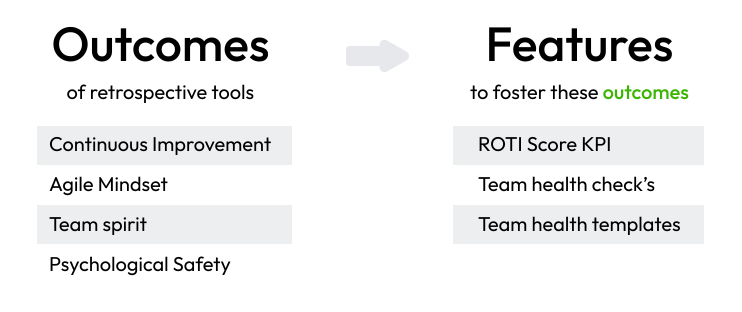
Which of the best free online retrospective tools is actually the best one with helping you get the given outputs and outcomes of agile retrospectives, doing retrospectives online?
I will now explain specifically what the outputs of retrospectives and the outcome of any online tool for agile retrospectives should be (More on: Agile Retrospective Board ). I will also name the specific features that - from my point of view - are directly connected with these outputs and outcomes. An example: If we have anonymous retrospective software, what is the outcome that I would expect from this feature (anonymity)?

Outputs of a Retrospective Software Tool
Here we go - overall I see 7 different outputs of retrospectives, online and offline.
- Action items: The online retrospective app tool should take into account the 6th phase of a retrospective (see above, explanations for Easyretro aka Funretro).
- Feature: Action Item Support & Tracking.
- Fun, engagement and flexibility: A retro as an agile ceremony can be very interactive and fun compared to other ceremonies. It should also be very flexible - the agenda can change due to urgent topics.
- Feature: Fun, interactive and flexible design (i.e., flexibility of a digital retro whiteboard).
- The right questions: The retrospective meeting tool should help ask the right questions and be flexible, i.e., adaptable to the team’s needs (More on: Retrospective Meeting Board ).
- Feature: Varied templates with good questions to reflect on past sprints and improve the team.
- Efficiency: The Sprint Retrospective Board is designed to help save time in the preparation and follow-up of the retrospective.
- Features: Pre-defined templates, optional asynchronous survey, support in facilitation, the right integrations with other tools, automated action item follow up.
- Good time boxing: In order to keep the team’s focus and the ROTI “Return on time invest” in balance.
- Feature: Effective timer.
- Safe atmosphere: To be able to speak up and share ideas without the fear of being judged by colleagues
- Feature: Optional anonymity when sharing feedback.
- Professionalism: Being perceived as a professional coach or engineering manager to gain the trust required for the long-term development of a team.
- Feature: Professionally designed & working retrospective software with intuitive UX. Mobile support for hybrid teams (More on: Free agile retrospective software ).
You can find an image above that shows a quick summary of the features I am mentioning here that any good free retrospective tool online should have.
All of these outputs have an influence on the outcomes of the retrospective (for any retro online and offline).
Outcomes of a teams retro
I see 4 different outcomes of doing retrospectives online (or offline and in general).
- Continuous improvement: One of the core ideas of Agile is continuous improvement - and the retrospective is the central ceremony to support this.
- Feature: Measuring the ROTI score, “Return on time invest”, as an indicator for the perceived quality of a retrospective (correlating with whether the time is worth it or whether you are actually improving).
- Agile Mindset: Regularly experiencing the positive effect of retrospectives, i.e. improving teamwork, leads to a phenomenon called “self-efficacy” in psychology. This phenomenon can have a massive impact on the “belief” in agile methods, in other words, on agile growth mindset - more on this in the linked article.
- Feature: Team health checks (or I should rather say Team fitness checks ) including analysis options over time can be a great help in regularly demonstrating how the team has improved in terms of agile maturity over time - which is very conducive to the agile mindset.
- Team spirit: One outcome of sprint retrospectives should be increased motivation and satisfaction of team members (i.e. something that could be called team spirit, although this is not a psychological term).
- Feature: A good team fitness check (incl. psychological validity & reliability) not only measures how you develop, but also to reflect on the psychological preconditions of team spirit & morale (e.g., the agile values).
- Psychological safety: Psychological safety is a precondition for sharing one’s ideas and thoughts openly, which is a precondition for learning and thus continuous improvement.
- Feature: Retrospective templates and questions that specifically foster psychological safety.
If you generally want to learn more about this, have a look at my post about 5 examples for outputs and outcomes of retros right now.
What’s pretty interesting given this: These outputs and outcomes match the overall impact of Agile Coaches pretty well, according to the State of Agile Q1/2022 (see graphic):

So there is a reason why retrospectives are called the core ceremony in Scrum (see: Retrospectives as a core ceremony): They can help you solve/achieve the key challenges/goals of Engineering Managers, Team Leads, Delivery Managers and Agile Coaches. Given these examples and facts, I hope you can understand why many argue that outcomes are more important than outputs (in general, not just in relation to Scrum Retros in Remote Sprint Teams).
So now you know why I am listing these 10 features as core features of (free) agile Retrospective tools that enable online retrospectives. Next, I’ll explain why I claim we’re comparing the 7 best retro tools.
##*Why are these the 7 “best” retro board softwares?
I wrote that these are the best retro board softwares for your teams’ retrospective and for conducting a remote retrospective. Why do I claim that - that they are the best?
Well, to be rather objective here, we tried to use numbers. In our case, we looked at website traffic. In the last months, these have been the pages with the highest traffic:

As you can see, Parabol (red line) and Easyretro (formerly FunRetro; purple line) have the highest traffic overall, followed at some distance by Echometer (blue) and the other tools for online retrospectives - which are all at a similar level. I have to add that Neatro is not listed here, simply because the comparison tool we used here (Ubersuggest) only allows you to compare 6 tools at the same time. I excluded it because Neatro has the least traffic from all the tools.
What you also cannot see: Of course, we also compared many other retro tools to carry out retrospectives online (see below, the honorable mentions). These simply had less traffic compared to the 7 best tools that we present in this article - but they may still be suitable, of course.
We also checked the traffic via Similarweb by the way, to have two different sources for the traffic data. It showed a similar pattern for the traffic of the Scrum retrospective tools. You can use Similarweb for free. So if you want to double check the traffic of the online retro tools on your own, feel free to do so.
Finally, it should be pointed out that higher traffic does not clearly prove that it is one of the “best” retro tools. However, for the purpose of this article, it served as a handy indicator as it was rather neutral.
Retrospective Board online: Some honorable mentions
To let you know which other online retro boards we have reviewed in our traffic comparison, I have added honorable mentions to the following section. To find even more remote retro tools, feel free to jump to our retro board comparison.
Online Retro Board Tool Alternative: Outro
“A new kind of retrospective for progressive teams.”
Outro website: https://outro.co/
What I like about it: Outro is a little side project by Taylor and Danny from NYC, who have a lot of experience with retrospectives. You can read their story and more about their tool on their website (More on: Project Retrospective Tool ).
Online Retrospective App Alternative: GoRetro
“GoRetro is an easy, fun, and customizable agile retrospective tool that uses sprint data and team sentiment to drive continuous improvement.”
GoRetro website: https://www.goretro.ai/
I haven’t tried this free online sprint retrospective tool, but it sounds and looks like a decent simple retrospective tool to do retrospectives online. Feel free to investigate on your own.
Online Retro Tool Alternative: Retrocat
“Easy retros for you and your team.”
Retrocat website: https://retrocat.app/
Retrocat offers the basic features of a free online retro tool. I haven’t delved deep enough to know how it is with the core features mentioned above - but it’s worth a look. I have to admit: What I don’t understand with this tool is the connection to cats…
Online Retro Tool Alternative: Miro
“Where teams get work done.”
Miro website: https://miro.com/
Okay, you probably already know Miro. It’s probably the most popular digital whiteboard tool out there. Why am I mentioning it here? Because I know that many Agile Coaches, Engineering Managers and Scrum Masters use Miro for their free online retrospectives by simply using an online whiteboard for their remote retrospective.
Advantages: Many people are used to using a whiteboard tool.
Disadvantage: You cannot call Miro or other pure whiteboard tools a software tool for agile retrospectives. It does not have many of the necessary features of an online retro board tool, including anonymity, action item support, ROTI score and health checks.
If you are looking for an online whiteboard for a retrospective, I would rather choose the following software as described above: Echometer or Metro Retro . The choice is yours! Both are creative retrospective boards (More about: Creative Retrospective Board ).
Online Retro Board Tool Alternative: Scatterspoke
“Run Better Retros. Build Happier Teams.”
Scatterspoke website: https://www.scatterspoke.com/
Scatterspoke describes itself as a “data-driven” tool. Which (as you may have noticed) I like, because I believe that data can be a great help when it comes to getting the necessary outcomes from retrospectives. An online tool for agile retrospectives to keep an eye on.
Online Retrospective App Alternative: retros.work
“Better team performance with online retrospectives”.
Retros.work website (pretty obvious): https://retros.work/
It looks like “retros.work” is a free online retrospective tool from a one-man show in the Netherlands - not bad! For this reason alone, this tool for online retrospectives is worth a look (More on: Retrospective Collaboration Tool ). But now, after all these retro tools, let’s draw a conclusion.
The best online retro tools compared
Conclusion: Who wins in the Retrospective Tool Comparison?
The market for free retrospective board tools is confusing. This makes it difficult to decide on a software tool. As my selection has shown, many online retro boards have their own approaches to improving teamwork. At the same time, however, many retro apps also offer the same features, so it is often not clear at first glance which tool is suitable for which requirements.
Hopefully this comparison has given you some guidance on which online retro board tool is best to use. As we are developers of one of these tools ourselves, we are of course biased as to which software tool we recommend. But I’ve tried to explain our decision-making framework for this recommendation as logically as possible. Feel free to give us feedback on our logic and the conclusion that Echometer is the best retrospective software board.
If you are looking for some fun retrospective questions, feel free to have a look at these 54 kickass retrospective ideas (More on: Software Retrospective Ideas ).
By the way: One of the most effective ways to sustainably develop the “mindset” of teams is to hold regular one-on-one meetings between engineering leads (or generally Servant Leaders) and software developers. We have developed a specialized software tool for this very purpose - you can take a look at it here: Echometers 1-to-1 Meeting Software .
Have fun with your next online retrospective - hopefully with the right software tool!
"Many team members are afraid to speak up!"
Solve this challenge "We discover too many unexpected issues & bugs at a late stage!"
Solve this challenge "Why does it sometimes take me hours to prepare a simple retrospective?"
Solve this challengeYou can find more retro ideas in our collection 32 Retrospective Methods .
Retro Boards: Frequently Asked Questions
The following questions will help you choose the right online retro board software.
What are the best retrospective software tools for remote development teams?
It depends on your team and your context which is the best retrospective software tool. A generally recommended software tool for virtual or remote engineering teams is Echometer. It has various features that have been specially developed for remote IT engineering teams, such as: an interactive retro board, various retrospective templates, action tracking and specialized team Health Checks for remote teams.
Where can I find retrospective software tools with customizable templates?
You can find retrospective software tools with customizable templates, formats and techniques on various platforms and in various software tools. For example, we recommend the retrospective software tool Echometer with customizable templates for retrospective questions and techniques. The templates in Echometer include selectable icebreakers and open questions for your retrospective, such as the techniques "Keep Stop Start", "Mad Sad Glad" or the sailboat retrospective.
What are popular retrospective tools in 2025?
The most popular retrospective tools in 2025 include in particular:
What is the cheapest alternative to the Retrospective Software Tool Parabol?
Depending on the size of your team, Echometer is the more affordable alternative to the retrospective software tool Parabol. Parabol charges $8 per team member, while Echometer charges per team. Since Echometer costs $29 per month for a full team, Echometer is more affordable if you have more than 3 team members - which is the case for most teams.
Is the Echometer Retrospective Software Tool suitable for younger and older software developers?
Yes, Echometer is suitable for all age groups: Younger software developers will enjoy the playful elements of the software, such as the balloon shooting in the retrospective waiting room. Older software engineers will appreciate the focus on efficiency and the simplicity of the tool.
Scrum, Kanban, Scrumban: Which framework is the Echometer retrospective software tool designed for?
Echometer works independently of frameworks and is therefore ideal for teams that work according to Scrum, Waterfall or Kanban, as well as software teams that use hybrid frameworks and methods such as Scrumban. Even if you don't use Scrum or an officially existing framework, Echometer is the right software tool for you.
What is important when choosing retrospective board software?
When deciding on a retrospective software tool, you should make sure that the online retro board can do more than just replace colorful sticky notes. Good retro software helps your team to work better together on an ongoing basis and ensures that the retros don't become routine.
What is the best retrospective software for beginners to get started with?
If an agile team does not yet have much experience with retrospectives, a tool that effectively guides you through the retrospective and offers many templates is recommended:
What is the best online retrospective tool for managers?
The best online retrospective tool, especially for managers of agile teams, is probably Echometer. Why?
What are the limitations of Parabol's retrospective tool?
Parabol is basically a good retro board tool for online retrospectives. Nevertheless, there are a few limitations and weaknesses of the Parabol software compared to Echometer as an alternative tool for team retrospectives:


