

Software Developer 1:1 Meetings: 4 Templates & 10 Questions
There is the cliché of the developer who prefers to program alone in a dark basement. But the reality is different: Software development is teamwork. And teamwork requires communication, both on a team and individual level.
To put it in your language, ignoring tech debt for too long is costly. But what about communication debt? When software developers don’t have the opportunity to discuss their personal challenges for weeks or months, invisible problems arise.
Which brings us to the topic: One-on-one meetings between managers and software developers or engineers.
Every developer is familiar with code reviews: You check whether the code is clean, understandable and efficient. One-on-one meetings are a kind of ‘people review’: a regular check to see whether the software engineer not only delivers technical requirements, but is also motivated, satisfied and continues to develop.
Whether in a digital or virtual one-on-one meeting, 1-to-1 meetings offer space for feedback and therefore personal development, which is essential in today’s working world. And in this article, I’ll give you good questions that you can use in your weekly, bi-weekly or monthly one-on-one meetings to have good conversations.
First of all: If you’re still unsure about what good one-on-one meetings look like, take a look at our guide: The guide with 6 tips for successful one-on-one meetings.
One-on-One Meeting Software Developer & Engineer: Questions & Template
6 typical challenges in the development of software engineers
One-on-one meetings with software developers differ from others because they are not only about project progress and goals, but also about typical technical and interpersonal challenges.
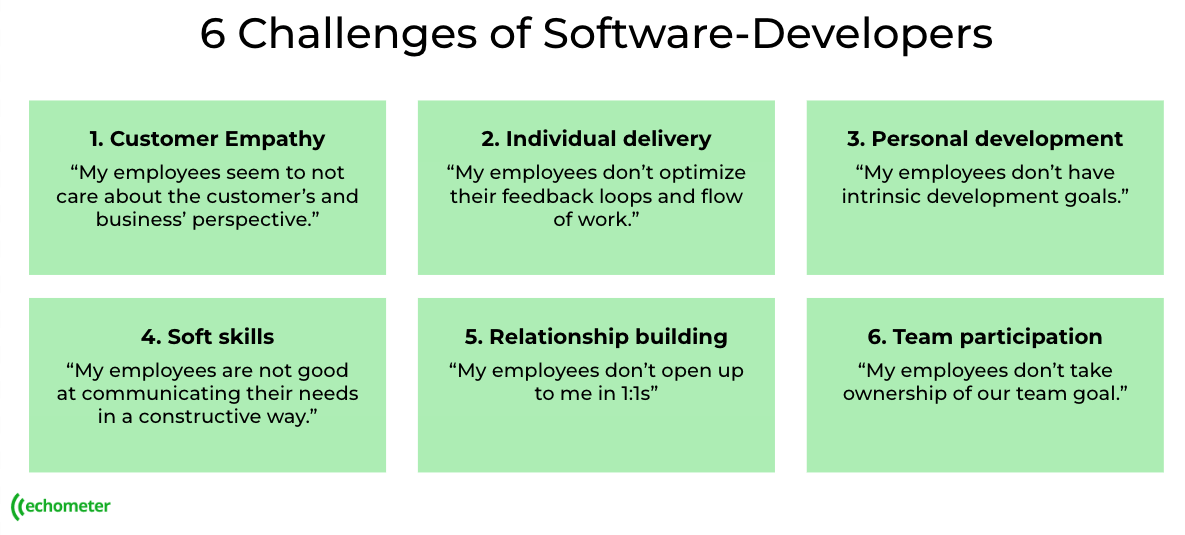
In discussions with around 100 Software Team Leads, Delivery Leads and Engineering Managers, a number of patterns emerged regarding the typical challenges faced by software developers (see image below).
While developers are often deep in code, 1:1s help to bridge the gap between technology and business –, for example, through greater customer empathy. They also provide space to reflect on individual delivery processes and develop more efficient workflows. Responsibility for team goals (team ownership) is also a major challenge, especially in agile teams.
On a personal level, 1:1s enable employees to develop into intrinsically motivated team members. Soft skills are also often a challenge – many developers find it difficult to communicate their needs constructively.
For one-to-one meetings to really work, good relationship building is crucial: without trust, many topics remain unspoken. Regular, well-managed 1:1 meetings help developers to grow in all these areas – and turn good coders into valuable team players.

Why am I telling you all this?
Of course, so that you know which fields you should systematically cover in your one-on-one conversation. I’ll provide you with specific templates and questions later on. But let’s start with a very general template first.
One-on-One Meeting Software Developer & Engineer: Questions & Template
A template for a classic one-on-one meeting with Software Developers
The fact that you clicked on this article tells me that you are looking for a template for one-to-one meetings with software developers.
That’s why you’ll first find a doc template here, which should be a good accompaniment to a classic monthly appraisal interview, for example.
By the way, you can save the template as a Doc under the actual template, but alternatively also as a PDF or Word document. Just click on the “Plus” toggle.

Getting started
- How was your week so far?
📊 Project Updates
- How are your current projects going? Are there any major successes or obstacles?
- Are there any technical challenges that you would like to discuss or think through together?
💻 Code quality & development
- How do you feel about the quality of your work lately?
- Are there any areas where you would like to improve or learn new skills?
🤝 Team, collaboration & next steps
- How is the collaboration in the team going? Are there any communication gaps?
- Do the tools and processes we use support your work effectively?
- How do you envision your career in the next one to two years?
- How can I help you be successful?
Closing
- What are you most looking forward to in the coming months?
- Do you have any further questions or concerns?
⁉️ Mood check (survey)
As you can see, the main aim of such a one-on-one conversation with software developers is to zoom out. This is often very difficult in everyday life, which is why a dedicated block of time is necessary.
By the way, don’t be fooled by the agenda: Basically, your goal should be for your intrinsically motivated software engineer to bring as many topics to the table as possible.
Now let’s move on to a template that takes a slightly more creative approach to the one-on-one conversation.

“I like the employee, but they aren't performing as desired. How can I address this in 1:1s?”
Solve this challenge
"Sometimes I’m not sure if I was too harsh - or too soft - in my 1:1s to be effective."
Solve this challenge
"I can’t identify patterns or trends across my 1:1s. Everything feels isolated."
Solve this challengeOne-on-One Meeting Software Developer & Engineer: Questions & Template
4 more helpful templates for one-on-one meetings (Doc)
A first step to getting more variety and engagement in your one-on-one conversation with your software developer is the following template.
It simply names 8 typical “wastes” that are often found in software teams.
The basic idea is then simple: Which of these wastes is the biggest time waster? Where is there potential for improvement?
One-on-one meeting template Echometer Software
- Take a look at the areas indicated here. Where do you and your team think you have the greatest potential for improvement?
Source: Echometer 1:1 Meeting Software
In addition to this template, there are of course other aspects that you can reflect on in your appraisal interview.
Having spoken to around 100 managers over the last few months, I have noticed a pattern.
Many supervisors occasionally incorporate small surveys into their one-on-one meetings. This means that they simply go through a few questions in a relaxed manner and ask their staff a) whether he or she agrees with a statement (for example from 1 to 7) and then b) why he or she answered in this way.
They expect the following from these micro-surveys in 1:1s:
- More variety and engagement in 1-to-1 conversations
- Taking on new perspectives
- Measurability of (soft) KPIs such as satisfaction over time
And of course you can also use this idea for your one-on-one meeting with your software developer. I have put together five statements for you here that focus on reflecting important preconditions for every successful employee.
You can also download this template as a Doc, but even better is the following: In our one-on-one meeting software, we have an integrated tool that makes the results visible as a metric over time and gives you tips with an AI assistant - feel free to take a look without logging in via the button below.
⁉️ Mood check (Agreement from 1-7): Personal development
- "My tasks usually progress very quickly, even if external feedback is necessary."
- "When I observe suboptimal behavior, I know how to constructively bring it to the attention of colleagues."
- "I receive constructive Feedback on both my work and my personal development."
- "I see an attractive career path ahead of me in the company." #Growth
- "In the last few weeks, I have very often been able to use my strengths at work."
This is what this survey looks like in Echometer:
As you can see, the statements address key preconditions of staff that feels happy.
Another prerequisite for healthy, productive employees is, of course, a good manager. Yes, I’m talking about you here.
And of course there are also statements that you can take with you into your one-on-one meeting. Specifically, here are 4 behavioral anchors that you can reflect on in a monthly one-on-one meeting with your employee.
⁉️ Mood check (Agreement from 1-7): Leadership quality
- "I am really satisfied with my team leader." #JobSatisfaction
- "My team leader regularly zooms out to explain the higher-level team goals, strategy and vision."
- "My team leader questions things in a constructive way." #Feedback #Leadership
- "My team leader exemplifies what he expects from us as a team." #Leadership
This is what this survey looks like in Echometer:
And finally, here is another template that is especially suitable for software developers. It focuses on some of the six challenges I mentioned at the beginning of this text, especially customer empathy and individual delivery.
🪞Employee review survey: For software developers
- I question our work based on my understanding of our #TeamGoals and the needs of our #Customers.
- I proactively contribute to the continuous improvement of our team. #TeamPlay
- I know the challenges and problems of our #Customers.
- My work tasks usually progress very quickly, even if external #Feedback is necessary.

Note: In this employee review template, agreement with the health check items (questionnaire) is requested on a 1-7 scale.
One-on-One Meeting Software Developer & Engineer: Questions & Template
10 clever questions for one-on-one meetings with software developers
So, as a supervisor or team lead, you should now have a good foundation for the one-on-one conversation with your direct report.
And yet I still have more tips for you. Because one thing is your agenda - the other thing is creative questions that you ask in the middle of a verbal battle. Especially in irregular one-on-one meetings, it is worth taking a bird’s eye view - and the following list of questions will help you with this.
🎯 1 to 1 questions for software developers: Focus
- What interrupts your concentration at work?
- When was the last time you experienced a state of flow at work? How easy is it for you to get into the flow?
- When and how have you noticed that you have exceeded your personal "Work In Progress Limit"? What could we change to help you achieve an appropriate WIP in the future?
- How are the contributions in the team distributed among you? How do you reflect on your role in it?
- Who are our customers as a company and how does your work specifically contribute to meeting the needs of the customers?
- What are the things you would like to learn when you think of your colleagues* in the company and beyond?
And, can you hardly wait to ask these questions in your one-on-one meeting? Very good, I’m glad.
If you would like more creative input, I can recommend our corresponding article: 129 Good One-on-One Meeting Questions (by a Psychologist) .
One-on-One Meeting Software Developer & Engineer: Questions & Template
15 more Templates for One-on-One Meetings (as Doc, PDF etc.)
You’ve probably already guessed it. Of course, there are many more templates for one-on-one meetings that you will need sooner or later.
For example, I talk about templates for your one-on-one meeting about salary, your conversation with a difficult employee or with a completely new employee.
We have additional templates for all of these use cases, which you can find in this article: 15 Free Proven One-on-one Meeting Templates to Edit & Print
One-on-One Meeting Software Developer & Engineer: Questions & Template
Conclusion: A really good 1-to-1 with software developers
The success of one-on-one meetings can be measured in the long term: Is an employee permanently satisfied and productive, is he or she developing further?
Routine sometimes creeps in, especially in many conversations, and the quality of one-on-one meetings decreases. That’s exactly why I wrote this text: Hopefully you have been inspired by the various questions for good appraisal interviews with software developers.
But you must not forget one piece of wisdom: There are countless questions you can ask - but the most important thing is that you tailor the conversation individually to your employees.
Our AI meeting assistant for one-on-one meetings can also help you with this. If you want to find out more about it, take a look at our website: The best 1-on-1 meeting software .
"Many team members are afraid to speak up!"
Solve this challenge "We discover too many unexpected issues & bugs at a late stage!"
Solve this challenge "Why does it sometimes take me hours to prepare a simple retrospective?"
Solve this challenge


