

Sprint Review vs. Retrospective: Simply explained with Image
Difference Between Sprint Review and Retrospective
We defined in the last article, what a retrospective really is . We also talked about Scrum as a framework for agile working methods. And in this framework, in addition to the retrospective, there is also a meeting format called Sprint Review.
So how do these two formats differ?
Sprint Review and Retrospective in the Scrum Cycle
The sprint review and retrospective are back-to-back in the Scrum cycle. The order has a reason, as we will see in a moment:
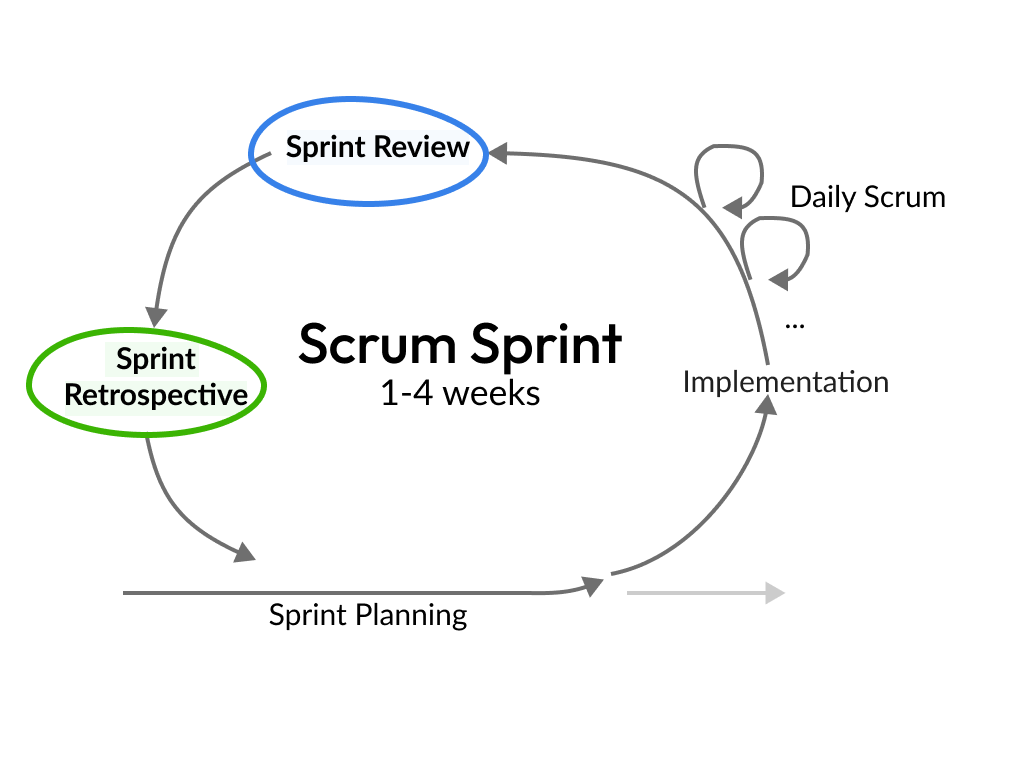

Sprint review vs. retrospective
Definition: Sprint Review
The Scaled Agile Framework Sprint Review is a workshop at the end of a Scrum Sprint cycle where a Scrum Team reviews what was accomplished during the last Sprint. Based on this, the so-called product backlog is updated.
Definition: Sprint Retrospective
The sprint retrospective however, takes place after the sprint review. Here the Scrum Team reflects on their collaboration and opportunities for improvement. In order to be able to fully carry out this reflection, a review must have taken place before the retrospective.
Differences Between Sprint Review and Retrospective
Here you will also find the differences clearly in table form:
| Sprint Review | Retrospective | |
|---|---|---|
| Focus | The work products of the last sprint | Continuous improvement of cooperation |
| Attendees | Team members (including developers, Scrum Master and Product Owner), and ideally also stakeholders (users, managers, customers or other specialist departments) | Only the team itself, i.e. developers, scrum masters and product owners |
| Time | At the end of the sprint, before the retrospective | At the end of the sprint, after the review |
Can I combine Sprint Review and Retrospective?
Yes, in principle Sprint Review and Retrospective can be combined. However, it is questionable whether the participants have enough energy to carry out these two comprehensive appointments in a row with full concentration.
As a rule, it is therefore recommended to plan at least one break between the sprint review and the retrospective. For example, ideally the sprint review would be in the morning and the retrospective in the afternoon. Alternatively, you can simply put the appointments on two consecutive days.
Conclusion: Sprint Review and Retrospective Are Not the Same
In short: In the Scrum cycle, the sprint retrospective takes place after the sprint review. While the sprint review focuses on the concrete work results, the retrospective focuses on the continuous improvement of cooperation.
By the way, if you are still looking for a suitable retro board (with 60+ agile retrospective formats), this post can help you: Comparing the 6 best retrospective boards

"Many team members are afraid to speak up!"
Solve this challenge
"We discover too many unexpected issues & bugs at a late stage!"
Solve this challenge
"Why does it sometimes take me hours to prepare a simple retrospective?"
Solve this challengeCredits: Pointing photo created by wayhomestudio - www.freepik.com


