

What is a retrospective? The 1-minute guide
What is a Retrospective?
Definition Retrospective
The term “retrospective” means looking back. In the work context, this usually means an “agile retrospective.”
An agile retrospective is a workshop format for reflecting on and improving collaboration. The role and implementation of an agile retrospective were defined in particular by the Scrum Guide. See: Scrum Guide
Even before retrospectives were used in the world of work, the term Retrospective already in the art world used for exhibitions that look back on the works of an artist. The big difference to retrospectives in the art world is that retrospectives in the work context also deal with how to further develop the work in the future, instead of exclusively looking back.
See also: Purpose and benefits of retrospectives (simply explained)
What is a Retrospective?
Retrospective Examples
The simplest example of a retrospective (and at the same time a popular retro format) is to simply ask:
- What went well?
- What went wrong?
- What can we try in the future?
Since the questions are about stimulating reflection, more and more methods for retrospectives have emerged over time. These include, for example, sailboat, starfish, or keep-stop-start retrospectives.
We have compiled a comprehensive overview of the best-known as well as unusual, creative retrospectives here: 32 retrospective methods
What is a Retrospective?
Retrospective Process
The agenda and phases of a retrospective basically take place (regardless of the format) according to a proven pattern:
- Check in
- Data gathering
- Prioritize
- Insides and Action Items
- Completion or check-out
Each of these steps can be customized and designed individually. However, it is always important take the Double Diamond concept when designing the retrospective into account.
What is a Retrospective?
Retrospective: Learning by Doing (Software for Beginners)
Do the phases and process of a retrospective sound too formal and off-putting to you? Don’t be unsettled and just try out a retrospective in a suitable software for retrospectives.
After one or two test runs at the latest, you will be familiar with the process. The best thing to do is to simply open the Keep-Stop-Start Retro in Echometer and familiarize yourself – learning by doing:
Keep stop start retro

Open questions
After this, you will already have a good feeling for how a retrospective works in practice and how you can moderate it.
What is a Retrospective?
Retrospective in Scrum
Many teams that have established retrospectives use the Scrum framework for organizing their cooperation.
With Scrum, the work is organized in iterative sprint cycles. Within these Scrum cycles, the retrospective is an integral part.
With retrospectives, Scrum ensures that teams reflect on their collaboration weekly or at least monthly, depending on the sprint length.
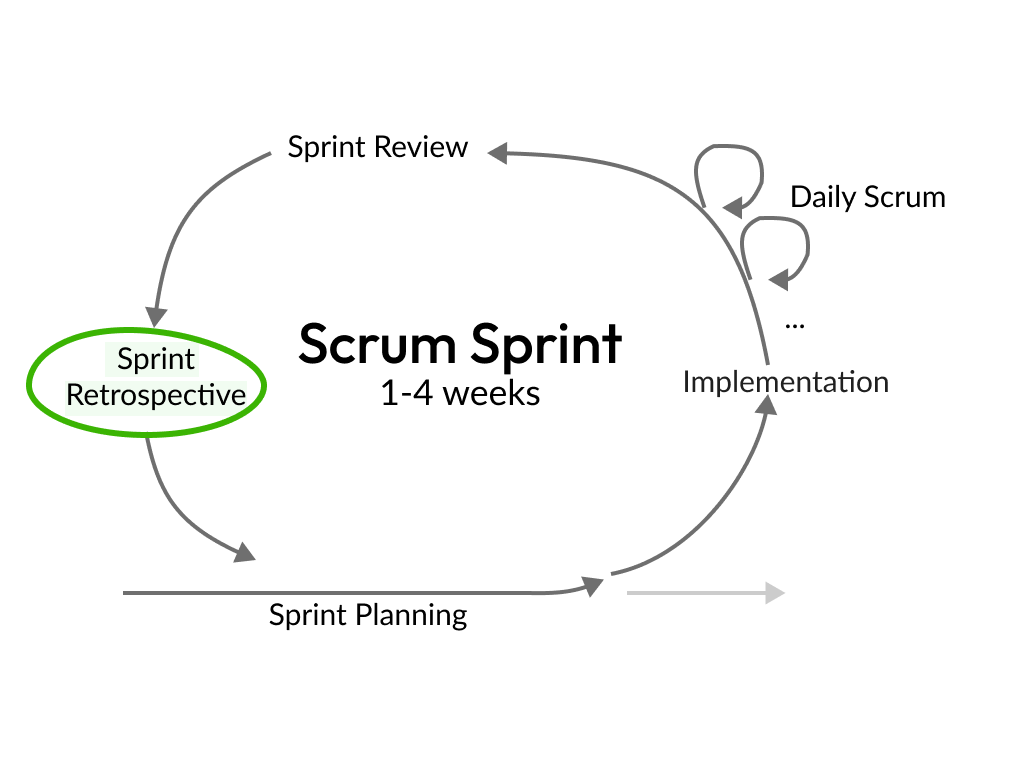
Retrospectives and Scrum belong together. But also other working methods like OKRs or Kanban use retrospectives:
- Kanban Retrospective – In Kanban you don’t work in cycles, but you have regular retrospectives (also sometimes referred to as Service Delivery Reviews ) in which one reflects the flow of work and collaboration.
- OKR Retrospective – With goal management via OKRs, at the end of each cycle, you reflect on how well the goals were set, how their measurement helped the team, and how you could improve the goal setting and tracking in the next OKR cycle.
What is a Retrospective?
What Makes a Good Retrospective?
A good retrospective allows all team members to openly share their impressions. If the feedback is shared openly, it must of course also be discussed openly and purposefully in the second step.
In order to create this atmosphere of conversation and openness, there is the so-called “Prime Directive,” which is ideally explained to all participants again at the beginning of the retrospective:
Regardless of what we discover, we must assume that everyone did the best that he/she could, given his/her knowledge, skills and abilities, the resources available and the situation at hand.
– Norman L. Kerth, Project Retrospectives: A Handbook for Team Reviews
Accordingly, good retrospectives are always characterized by relatively balanced speaking shares. Especially with inexperienced teams, a good retro facilitation is essential.
In this context very exciting: We have analyzed over 30,000 retrospectives and published our findings from this analysis in our blog: The big analysis of 30,000 retrospectives
Check out our eBook for more tips and tricks: eBook: 20+ Facilitation Tips for Great Retrospectives
What is a Retrospective?
How Long Does a Retrospective Take?
A retrospective usually lasts 60 to 90 minutes. We do not recommend going far beyond 90 minutes, as the attention span decreases over time and the team members become tired.
However, retrospectives can also be shorter than 60 minutes. Here our tips for short retrospectives
What is a Retrospective?
Can you also do a retrospective remotely?
Of course, with the right remote retro tool (like Echometer) retrospectives can be carried out both on-site, completely remotely and in hybrid setups.
Retrospectives are a key for remote teams in particular for remote team building .
What is a Retrospective?
Anti-Patterns: What a Retrospective is NOT
Often, retrospectives are popularly confused with Sprint reviews or Lessons learned workshops Therefore, in these articles we have worked out what a retrospective is not and where the differences lie:
- Differences Sprint Review vs. Retrospective : Retrospective focuses not only on the team’s work result, but on the meta-level of collaboration in the team and how the collaboration led to the result.
- Differences Lessons Learned Workshops vs. Retrospective : Retrospectives take place continuously, not once at the end of a project.
Of course, there are also further content-related retrospective anti-patternsthat describe what a retrospective should not be.
What is a Retrospective?
Conclusion: Retrospectives are a central meeting routine of agile teams
Teams that want to continuously develop themselves and their collaboration use retrospectives. For these agile teams, retrospectives are a central meeting format in which they reflect on their collaboration, evaluate their measures and derive new actions from them.
So if your team isn’t already using retrospectives for continuous improvement, now is a good time to get started!
Try a Retrospective in EchometerCredits: Woman thinking photo created by wayhomestudio - freepik


